

I. The First Wall Was an Altar
A hand appears on stone. Around it, pigment blooms like a red cloud. The flesh has vanished. The name has vanished. The voice, tribe, hunger, weather, language, and breath have vanished. Still, the hand remains.
That hand is among the most powerful images in human history because it tells us something plain and staggering: art began when man learned to make absence visible. The body withdrew, yet the sign endured. The cave wall became a witness.
Cave painting stands at the origin of art because it joined image, ritual, fear, craft, and sacred attention into a single act. The earliest painter did far more than decorate stone. He entered darkness, carried fire into the earth, prepared pigment, and gave visible form to the creatures that ruled his world. His art grew from encounter. It was born from the animal’s power, the cave’s silence, the hand’s claim upon time, and the human need to answer majesty with form.¹
The cave was the first gallery, but it was also a sanctuary. The gallery labels came later, like little tombstones for astonishment.
II. Art Begins Underground
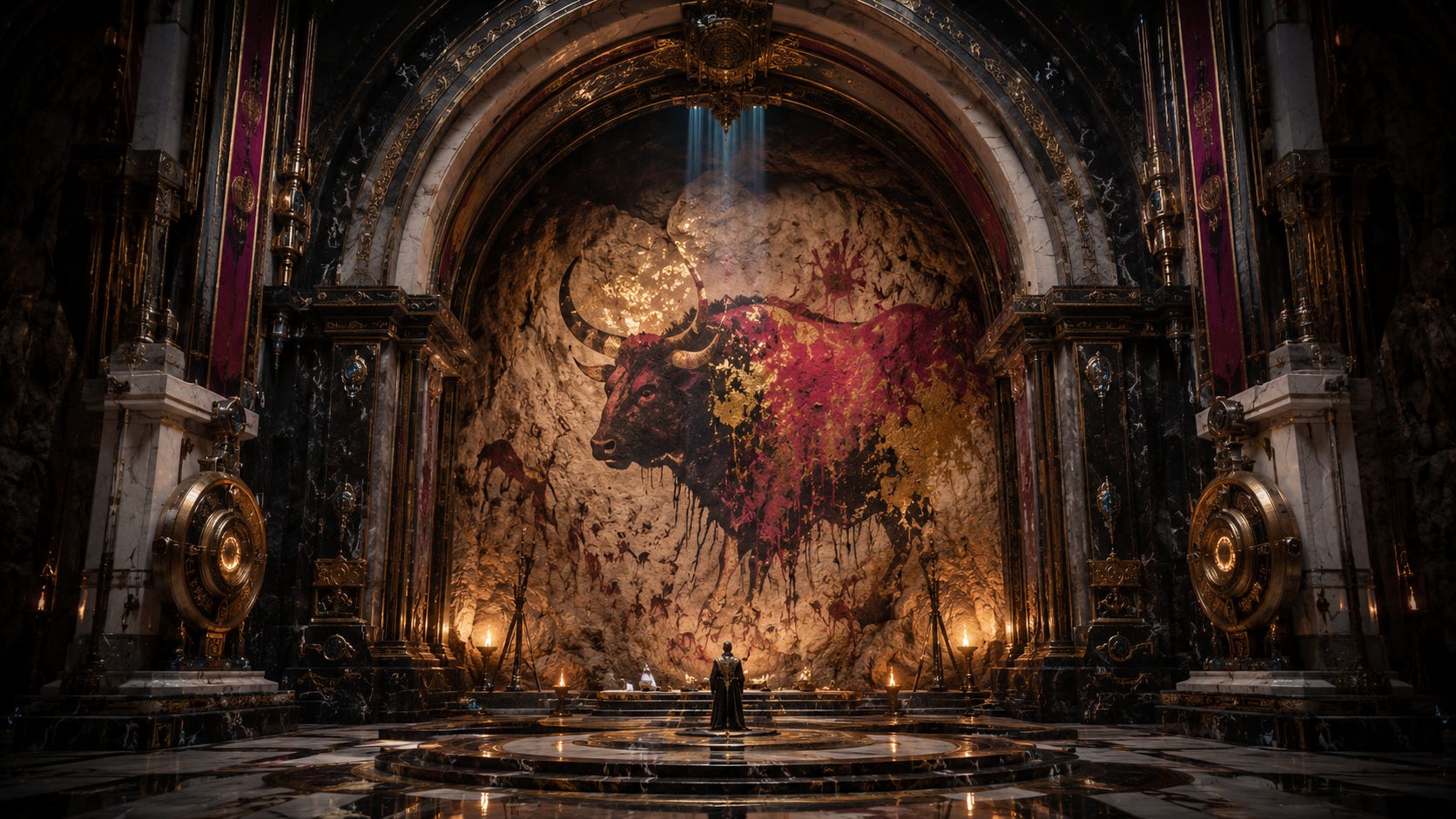
The setting matters. Many of the great Paleolithic images appear deep within caves, in chambers separated from the ordinary activities of living. Lascaux, Altamira, and Chauvet demand movement into enclosed space, away from daylight and daily work. The painter entered a charged interior where darkness governed the senses and fire became the condition of vision.²
This descent altered the act of seeing. Above ground lay the world of weather, hunger, kinship, and danger. Below ground lay a zone set apart. To cross that threshold was to leave ordinary space and enter symbolic space. Mircea Eliade’s account of sacred space helps clarify the matter: sacred places reveal a break in ordinary extension, a point where the world becomes ordered around a center.³
The cave wall served that purpose. It gathered attention. It separated the visible animal from the ordinary animal. A horse seen on the plain could flee. A horse painted in darkness remained, shimmering in firelight, summoned into presence by pigment and ritual care.
The first art began underground because man needed depth before he needed display.
III. The Animal as Sacred Presence
The animals on cave walls were large, dangerous, swift, nourishing, and strange. Bison, horses, deer, aurochs, mammoths, and lions appear as powers before they appear as subjects. They fed early man, threatened him, amazed him, and exceeded him. Their bodies moved with a force human beings had to study, fear, pursue, and honor.
Interpretations of cave art have varied across the last century. Some scholars stressed hunting magic. Others emphasized shamanic experience, initiation, social meaning, or symbolic order.⁴ The wisest reading refuses to crush the images into one tidy explanation. Early art likely carried many meanings because sacred things carry many relations at once.
The animal on the wall was a presence. It stood for dependence, terror, desire, and reverence. Early man painted what possessed majesty. He did far more than record a creature. He answered it.
John Ruskin argued that art becomes great when it is rooted in truth to nature and moral seriousness.⁵ The cave painter had both, in a raw and primordial form. He knew the animal’s body because his life depended on reading it. He honored the animal because his world had room for awe. The result still amazes after thousands of years, while many recent canvases expire mentally before the wine reception ends.
IV. The Human Hand and the Birth of Self-Consciousness
The hand stencil may be the most moving form in prehistoric art. It is personal and anonymous at once. We do not know the painter’s name. We know the outline of his hand.
That is enough.
The handprint marks a great change in human awareness. An animal leaves tracks because it passes through mud or dust. Man leaves a symbol because he understands presence can be separated from the body. The hand on the wall says: I can make a sign of myself. I can outlast the moment. I can speak through matter.
Cave art reveals the birth of self-conscious image-making. The painter becomes aware of himself as a maker of signs. He also becomes aware of time as something that can receive a mark. Henri Breuil saw Paleolithic art as bound to ritual life, with images bearing power far beyond aesthetic pleasure.⁶ Even where later scholarship revises his claims, his core instinct remains valuable: these images belong to a world where representation had force.
The hand is the first signature of mankind, but it is stronger than a signature. A signature claims ownership. A handprint claims presence.
V. Firelight Made the First Theater
Cave paintings were viewed by flame. This fact changes everything.
Under torchlight, the wall breathes. The stone bulges, sinks, curves, and fractures. A bison painted across a swelling surface appears to carry mass. A horse stretched along a curve seems ready to move. The flicker of fire gives the image a pulse. The cave painter worked with geology as much as pigment. He saw the animal hidden in the stone and drew it forth.
This is why cave painting can feel strangely close to theater, cinema, and virtual reality. The earliest image-worlds were immersive. The viewer entered them bodily. The image surrounded him. The fire animated the surface. Sound would have carried through chambers with unnerving force.⁷
Our glowing screens are younger relatives of the cave wall. Silicon Valley has spent enormous sums rediscovering what Paleolithic painters knew with charcoal, ochre, and flame: images become powerful when they command space, light, body, and attention together. The subscription plan was added later, proving that civilization sometimes climbs the mountain in order to invent a toll booth.
VI. Pigment, Earth, and Craft
The earliest artists worked with earth. Ochre, charcoal, manganese, minerals, animal fat, bone tools, and hollow reeds formed the grammar of prehistoric image-making. The hand, mouth, breath, and body served as instruments.⁸ Art began through contact with matter.
That matters because art was first craft before it became theory. The cave painter ground pigment, prepared a surface, studied forms, entered darkness, and worked by flame. The act demanded patience, skill, memory, and bodily discipline. Beauty came through labor joined to reverence.
This gives the cave painter a higher station than the modern “creative” trapped between a ring light and an invoice. The early artist possessed less vocabulary and more seriousness. He approached the wall as a maker confronting powers larger than himself. His work carried weight because his world carried weight.
Ruskin’s defense of craft helps us see this more clearly. For Ruskin, handmade work bears the trace of moral life because the maker’s attention enters the object.⁹ The cave wall bears this trace in primal form. Every line tells us that art begins when the human hand, trained by need and guided by wonder, transforms matter into meaning.
VII. The Cave as Womb, Tomb, and Cosmos
The cave’s symbolic force cannot be separated from the images. A cave is a depth in the earth. It is dark, enclosed, ancient, and silent. It evokes womb, tomb, and hidden cosmos at once. It receives bodies, echoes voices, shelters animals, and leads the living below the surface of ordinary experience.
To paint in such a place was to inscribe meaning into the body of the earth. The wall was never neutral. Stone had age. Darkness had force. The act of painting there carried a gravity that a flat domestic wall could never possess.
Eliade’s work on archaic religion suggests that traditional man lived inside a cosmos filled with signs, thresholds, and charged places.¹⁰ The cave fits that pattern. It was a passage into hidden order. The painter did not bring meaning to emptiness. He discovered meaning already pressing against him from the stone.
Here the origin of art becomes clear. Art began when man treated matter as capable of revelation. Pigment met stone, and the world became legible.
VIII. The Origin of Art Was Religious
The first great art was sacred art.
This does not require a complete doctrine, a priestly class, or a written creed. Religion begins before theology becomes systematic. Awe precedes commentary. Ritual precedes the lecture hall, which arrives later carrying footnotes and a sandwich.
Cave painting shows man encountering a world charged with presence. The animal was no bare object. The cave was no bare shelter. The hand was no bare anatomy. Each became a vessel of meaning. The earliest art arose from this charged relation between human beings and powers beyond them.
David Lewis-Williams argued that cave art may have been connected to altered states, trance, and shamanic perception.¹¹ Some of that argument remains debated, yet it captures an important truth: these images point beyond ordinary seeing. They belong to a world where vision was thick with spiritual consequence.
Art began as a way of standing before greatness. It gave form to fear, gratitude, dependence, and wonder. Decoration came later. Content came much later. The sacred came first.
IX. What Much Recent Art Forgot
The cave paintings expose the smallness of much recent art. The problem is not strangeness. Cave painting is strange. The problem is thinness.
The cave painter faced hunger, animal power, darkness, death, and eternity. Much recent art faces the artist’s mood and asks the public to clap for the weather report. There is a difference between inwardness and shrinkage. One can deepen the world. The other turns the gallery into a diary with better lighting.
Cave art teaches that greatness in art requires reverence. The artist must face something beyond personal appetite. That something may be God, animal life, civic order, heroic memory, sacred architecture, martyrdom, judgment, beauty, or the strange majesty of creation. A civilization that loses reverence may still produce clever objects. It struggles to produce sacred ones.
The practical lesson for the digital age is plain. Our tools can make images instantly, but instant production can flatten seriousness. The question is what we ask images to serve. A screen can become a cave wall when it gathers attention toward wonder. It becomes a vending machine when it exists to keep thumbs twitching.
X. The First Aesthetic Was Wonder
Cave painting matters because it shows the first human refusal to live by appetite alone. Early man hunted, feared, ate, suffered, and endured. Then he entered darkness and painted.
That act is the birth of art.
The animal on the wall was an answer to majesty. The handprint was an answer to time. The cave itself was an answer to the sacred depth of the world. Together, they reveal that art began when man reached beyond survival and made visible the invisible order pressing upon him.
The first painter did not explain himself. He left a sign.
Thousands of years later, the hand remains on the stone. It is fragile and grand. It tells us that beauty began in darkness, beneath the earth, where fire touched pigment and man discovered that matter could speak.
For the full 40-minute episode of The Grand Vision, listen to the companion podcast on cave painting, sacred fear, and the first visible religion.
Notes
¹ Jean Clottes, Cave Art (London: Phaidon, 2008), 12–19.
² Paul G. Bahn, The Cambridge Illustrated History of Prehistoric Art (Cambridge: Cambridge University Press, 1998), 118–41.
³ Mircea Eliade, The Sacred and the Profane: The Nature of Religion, trans. Willard R. Trask (New York: Harcourt, 1959), 20–65.
⁴ André Leroi-Gourhan, Treasures of Prehistoric Art, trans. Norbert Guterman (New York: Harry N. Abrams, 1967), 85–118.
⁵ John Ruskin, Modern Painters, vol. 1 (London: Smith, Elder, 1843), 1–46.
⁶ Abbé Henri Breuil, Four Hundred Centuries of Cave Art (Montignac: Centre d’Études et de Documentation Préhistoriques, 1952), 24–39.
⁷ Iégor Reznikoff, “On the Sound Related to Painted Caves and Rocks,” in Archaeoacoustics, ed. Chris Scarre and Graeme Lawson (Cambridge: McDonald Institute for Archaeological Research, 2006), 79–84.
⁸ Michel Lorblanchet, The First Artists: In Search of the World’s Oldest Art, trans. Paul G. Bahn (London: Thames & Hudson, 1998), 65–91.
⁹ John Ruskin, The Stones of Venice, vol. 2 (London: Smith, Elder, 1853), 151–92.
¹⁰ Eliade, Images and Symbols: Studies in Religious Symbolism, trans. Philip Mairet (Princeton: Princeton University Press, 1991), 27–56.
¹¹ David Lewis-Williams, The Mind in the Cave: Consciousness and the Origins of Art (London: Thames & Hudson, 2002), 120–69.
Bibliography
Bahn, Paul G. The Cambridge Illustrated History of Prehistoric Art. Cambridge: Cambridge University Press, 1998.
Breuil, Abbé Henri. Four Hundred Centuries of Cave Art. Montignac: Centre d’Études et de Documentation Préhistoriques, 1952.
Clottes, Jean. Cave Art. London: Phaidon, 2008.
Eliade, Mircea. Images and Symbols: Studies in Religious Symbolism. Translated by Philip Mairet. Princeton: Princeton University Press, 1991.
Eliade, Mircea. The Sacred and the Profane: The Nature of Religion. Translated by Willard R. Trask. New York: Harcourt, 1959.
Leroi-Gourhan, André. Treasures of Prehistoric Art. Translated by Norbert Guterman. New York: Harry N. Abrams, 1967.
Lewis-Williams, David. The Mind in the Cave: Consciousness and the Origins of Art. London: Thames & Hudson, 2002.
Lorblanchet, Michel. The First Artists: In Search of the World’s Oldest Art. Translated by Paul G. Bahn. London: Thames & Hudson, 1998.
Reznikoff, Iégor. “On the Sound Related to Painted Caves and Rocks.” In Archaeoacoustics, edited by Chris Scarre and Graeme Lawson, 79–84. Cambridge: McDonald Institute for Archaeological Research, 2006.
Ruskin, John. Modern Painters. Vol. 1. London: Smith, Elder, 1843.
Ruskin, John. The Stones of Venice. Vol. 2. London: Smith, Elder, 1853.