

I. Introduction
In contemporary consumer society, luxury goods are frequently marketed as devices of upward symbolic mobility. Their social function is less practical than representational. A handbag, watch, shoe, fragrance, or article of clothing is purchased not primarily for utility but for what it is taken to signify about the person who possesses it. In such cases, the commodity acts as a portable sign of refinement, status, or distinction. This structure of desire is especially visible where luxury branding is directed toward buyers of modest means, for whom the purchase of prestige goods may serve compensatory or aspirational ends.
Such patterns are often dismissed as ordinary features of market society. That judgment is historically shallow. The modern reduction of luxury to private signaling obscures the fact that luxury goods first acquired their authority in religious and ceremonial life. Their original force did not derive from brand identity, consumer aspiration, or personal vanity. It derived from sacred use. Precious goods were initially ordered toward temples, liturgies, offerings, funerary rites, priestly garments, sacred architecture, and royal ceremonies integrated with cultic systems. Luxury in its earliest and most formative sense was not a language of lifestyle. It was a language of sanctity, rank, and reverence.1
This distinction matters because it changes the moral and historical evaluation of luxury itself. The problem is not that luxury exists. The problem is that luxury has been detached from the institutions and purposes that once gave it legitimacy. Where costly objects once marked sacrifice, office, inheritance, and divine service, they now circulate as commercialized fragments of a lost symbolic order. The result is not cultural elevation but symbolic degradation.
II. Luxury and the Sacred Order
The earliest durable forms of luxury were embedded in sacred environments. In the ancient Near East, the eastern Mediterranean, and many later civilizations, gold, precious stones, incense, dyed fabrics, and expertly crafted vessels were linked to divine worship and sacrificial practice. Such materials were not valued solely because they were rare. They were valued because rarity, durability, brilliance, fragrance, and artisanal refinement rendered them suitable for the representation of sacred presence and sacred distance.2
In this sense, luxury goods served a theological function before they served a social one. Their use marked a boundary between ordinary and consecrated space. Gold in cultic settings did not merely display wealth. It registered the gravity of divine proximity. Incense did not simply smell pleasant. It transformed atmosphere, indicated offering, and marked ritual transition. Fine textiles did not merely adorn the body. They rendered sacred office visible. Precious materials gave external form to the ranked structure of a civilization’s highest commitments.
This point is particularly clear in the study of ancient Israelite religion. Gold in biblical cultic contexts carried significance irreducible to economic prestige. It was bound to the construction of holy space, the furnishing of ritual objects, and the visible expression of divine honor. Its meaning was theological before it was commercial.3 Similar patterns appear across temple economies more broadly, in which the circulation of precious goods was linked to ritual expenditure, religious patronage, and offerings made to deities.4
The sacred origin of luxury is therefore not incidental. It is constitutive. Luxury first emerged as a material grammar through which civilizations distinguished the holy from the ordinary. To say that luxury began in religion is not to make a sentimental claim about the past. It is to identify the institutional setting in which precious materials first acquired their normative force.
III. Material Splendor and Ritual Function
The religious origins of luxury become clearer when specific categories of goods are examined. Gold, incense, gems, polished metals, carved ivory, silk, embroidered textiles, and ceremonial vessels all appear early in ritual, funerary, and temple contexts. Their significance lay in the convergence of material excellence and ritual appropriateness. The goods were precious because they were fitted to high use. The standard of value was not personal consumption but ceremonial fitness.
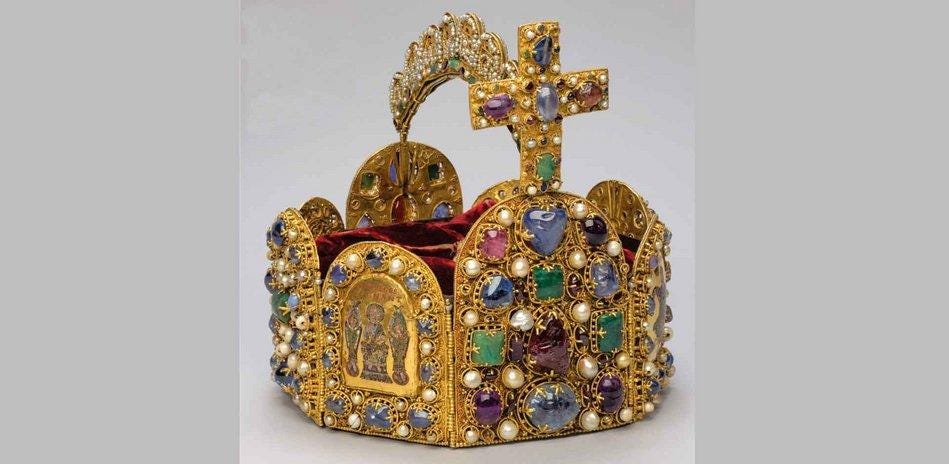
The ancient incense trade is instructive. Aromatics such as frankincense and myrrh became highly valued across regions not because they were arbitrary objects of taste but because they were indispensable to ritual systems, elite offerings, and funerary practices. Their luxury status cannot be understood apart from the sacred demand that sustained their trade.5 In similar fashion, precious stones and metalwork entered public significance through cult statuary, temple furnishing, royal regalia, and burial assemblages. Across many civilizations, the most elaborate objects were made for the gods, the dead, and the offices nearest to both.
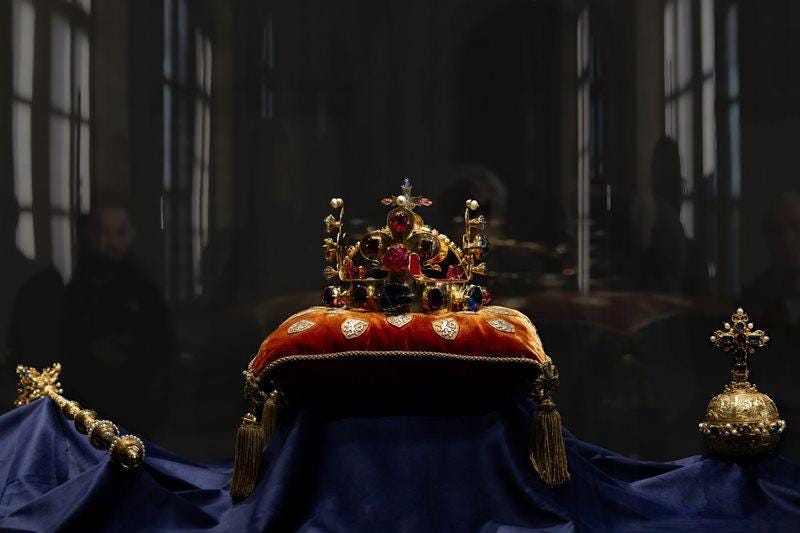
This precedence shaped later political and social life. Courts inherited from temples a language of radiance, order, and distinction. Royal ceremonial drew legitimacy from proximity to sacred models. The brilliance of courtly display was never wholly secular, even where political authority later differentiated itself from priestly authority. Temporal power learned how to appear authoritative through visual languages first stabilized within sacred institutions.
The modern luxury market continues to exploit this inheritance while disavowing its origin. Retail presentation often preserves a faint liturgical structure. Objects are isolated, illuminated, guarded, and framed as though reverence were still appropriate. Yet the object is now severed from sacrificial, civic, or sacred function. What remains is the shell of sanctity. Commercial luxury is often religious form without religious content. The old reverence survives as a sales technique.
IV. Garment, Office, and Visible Hierarchy
The case of clothing illustrates the matter with particular force. In both ancient and medieval societies, dress was rarely understood as a matter of private aesthetic preference alone. Clothing communicated rank, office, ritual state, gendered role, and civic belonging. This was especially true where sacred and political orders were closely intertwined. Garments were socially charged because they rendered hierarchy visible.
In ancient Greek evidence, clothing regulations often had sacred as well as civic dimensions. Rules governing attire in sanctuaries, festivals, and public rites indicate that dress was understood as part of ritual order.6 A garment could be improper not because it violated taste but because it violated place, status, or sacred propriety. The body in public was not treated as a purely expressive surface. It was treated as a site of moral and ceremonial order.
Christian liturgical vestments intensified this principle rather than discarding it. Vestments developed as a material language of sacred office. Their richness was not merely decorative. It distinguished clerical function from lay participation and clarified rank within the sacramental order. Textile splendor belonged to liturgical seriousness because the liturgy itself was treated as the highest public act of the community.7 In such contexts, precious fabric and ornament did not signify private wealth. They signified office exercised under transcendent authority.
This older grammar of dress has largely disappeared from modern mass society, though fragments of it remain in military uniforms, judicial robes, academic regalia, and formal religious traditions. Fashion culture survives by appropriating debris from these older systems while stripping away their binding functions. The result is a social field saturated with signs that no longer possess stable referents. A garment may still connote authority, austerity, sensuality, mourning, prestige, or seriousness, but the institutional framework that once disciplined such meanings has weakened dramatically.
The collapse of that framework has commercial consequences. Clothing can now simulate rank without conferring responsibility. It can imply refinement without education, gravity without office, and wealth without inheritance. This is one of the conditions under which modern luxury fashion becomes morally ambiguous. It no longer marks order. It markets the sensation of order to consumers cut loose from it.
V. Sumptuary Law and the Regulation of Splendor
Premodern societies often recognized the dangers inherent in visible luxury and responded through sumptuary regulation. Such laws have frequently been interpreted as crude instruments of repression or elite jealousy. That interpretation captures part of the story, though it misses the larger point. Sumptuary laws reveal that many societies understood luxury as a force with civic and moral consequences. Splendor was regulated because splendor taught. It shaped perception, organized aspiration, and mediated public distinctions.
The social logic of such laws was broad. They sought to preserve rank markers, restrain extravagance, protect inherited hierarchies, and prevent the blurring of symbolic boundaries upon which legal and political order depended. In medieval English Ireland, for instance, dress regulations controlled visible signs of social identity with remarkable specificity. Such rules were concerned with more than vanity. They were bound to governance, ethnicity, status, and the maintenance of public distinctions.8
The deeper premise of sumptuary law was that external magnificence cannot be treated as morally neutral. When signs of rank and sanctity are freely imitated, social trust deteriorates. If the visible language of office, dignity, and public authority may be appropriated at will, appearance detaches itself from the disciplines that once warranted it. Fraud becomes easier. Performance displaces order. Public life fills with symbolic counterfeit.
Modern commercial society rejects this premise in theory while rediscovering it in degraded form through branding, credential display, and algorithmically managed reputation. It insists that signs are open to all, then quietly reconstructs new status codes through consumption patterns. The old sumptuary world at least understood what it was doing. The present one performs egalitarianism while monetizing hierarchy more aggressively than many aristocracies ever did. This is one of modernity’s smaller ironies, though it is a durable one.
VI. Commercial Diffusion and Symbolic Hollowing
Luxury did not cease to exist when sacred and courtly systems weakened. It changed carriers. As trade expanded and precious goods circulated more widely, objects once tied closely to ritual and office entered broader arenas of elite consumption, diplomatic exchange, and eventually commercial aspiration. This process did not destroy the prestige of luxury goods immediately. It diluted and redistributed that prestige.
The reception of eastern goods in Roman society illustrates the mechanism. Goods imported through long-distance exchange acquired value within Roman cultural systems because they could be incorporated into existing languages of distinction, refinement, and power. Their luxury status was not a fixed property of the objects themselves. It was socially assigned through context and use.9 This helps explain how sacred and ceremonial objects could, over time, migrate into increasingly secular forms of display.
Such migration had significant effects. Once precious goods circulated outside the institutions that had stabilized their meaning, they became vulnerable to new forms of interpretation and misuse. A vessel once fit for offering could become a mark of private taste. A textile once suited to sacred office could become a prestige garment. A fragrance once tied to worship or burial could become an accessory of lifestyle and seduction. The material form survived, though the normative frame weakened.
Commercial society radicalized this trend. Industrial production, advertising, and modern finance made it possible to disseminate prestige goods at scales and speeds previously impossible. The luxury market increasingly sold signs detached from the structures that had generated them. Consumers were invited to purchase symbolic elevation without corresponding entry into office, rite, or inherited form. Under such conditions, luxury became increasingly theatrical. It continued to signify importance while losing stable grounds for doing so.
This is the central historical transition. Luxury moved from consecration to circulation. Once that occurred, symbolic inflation became difficult to resist. The sign of distinction could now be manufactured, branded, and sold independently of the practices that once gave distinction substance.
VII. Modern Luxury and the Defrauding of the Poor
The modern degradation of luxury is most visible where prestige goods are sold to economically vulnerable consumers as substitutes for dignity, belonging, or social rescue. In such cases, luxury functions as an instrument of symbolic extraction. The buyer is not purchasing durable entrance into a higher form of life. He is purchasing the appearance of that entrance. The transaction therefore depends on a confusion between sign and substance.
This confusion is socially costly. Human beings have enduring appetites for beauty, rank, ceremony, and meaningful distinction. These appetites are not inherently corrupt. They are rooted in the symbolic and hierarchical dimensions of social life. In healthy civilizations, such needs are mediated through religious ritual, family inheritance, communal feast, public office, and recognized forms of honor. In disordered societies, those mediating institutions weaken. The market then steps into the vacuum and offers commodified substitutes.
Prestige technologies, as theorized in archaeological work, derive much of their force from social valuation rather than practical necessity.10 Their effectiveness lies in organizing attention, signaling recognition, and stabilizing status perception. The modern luxury industry exploits precisely these mechanisms. It packages symbolic intensity and sells it as self-possession. Yet where no real office, formation, or communal recognition lies behind the object, the promise is structurally false.
This is why the mass marketing of luxury goods to the poor deserves description in more severe terms than mere persuasion. It is often a form of symbolic fraud. The object is made to carry hopes it cannot fulfill. A logo cannot confer dignity. A watch cannot create rank. A handbag cannot supply inheritance. The buyer’s longing may be real, though the commodity addresses it falsely.
The cruelty of this arrangement lies in its parasitic quality. It feeds on the remains of sacred and hierarchical symbolism while denying access to the institutions that once made such symbolism truthful. The poor are sold costumes after the drama has already been canceled.
VIII. Conclusion
Luxury goods originated within systems that treated material splendor as appropriate to what was held highest. Their first home was the sacred sphere, later joined by courts, offices, and ceremonial institutions that borrowed heavily from religious grammars of distinction. In that original setting, luxury served public and transcendent ends. It marked sanctity, office, sacrifice, memory, and hierarchy. It did not exist as a floating field of consumer self-expression.
The modern luxury order represents a long process of desacralization and diffusion. Precious goods moved from altar to court, from court to elite display, from elite display to commercial circulation, and from commercial circulation to mass symbolic aspiration. With each transition, the connection between luxury and higher purpose weakened. What remains in many contemporary settings is a shell of reverence organized for extraction rather than honor.
This historical account does not require a rejection of luxury as such. It requires a distinction between ordered luxury and debased luxury. Ordered luxury is directed toward what stands above appetite. Debased luxury is directed toward appetite while borrowing the visual language of higher things. The former strengthens civilizational form. The latter hollowes it out.
The final issue is therefore civilizational rather than merely economic. A society reveals its hierarchy of loves by the objects to which it grants splendor. Where its finest goods serve worship, solemn feast, ancestral continuity, and public office, luxury retains dignity. Where they serve mass insecurity and commercial manipulation, luxury becomes a polished form of decay.
Goodrich, P. (1998). Signs taken for wonders: Community, identity, and “A history of sumptuary law.” Law and Literature, 10(2), 307-346. https://www.jstor.org/stable/828879
Hayden, B. (1998). Practical and prestige technologies: The evolution of material systems. Journal of Archaeological Method and Theory, 5(1), 1-55. https://www.jstor.org/stable/20177377
Amzallag, N. (2019). Beyond prestige and magnificence: The theological significance of gold in the Israelite cult in relation to its economic value and symbolic function. Journal of Biblical Literature, 138(3), 539-566. https://www.jstor.org/stable/26855790
Cobb, M. A. (2013). The reception and consumption of eastern goods in Roman society. Greece & Rome, 60(1), 136-152. https://www.jstor.org/stable/43298108
Avanzini, A., Bianchi, A., & Piacentini, V. F. (Eds.). (2007). Food for the gods: New light on the ancient incense trade. Macmillan. https://www.jstor.org/stable/j.ctt1cfr8bq
Mills, H. (1984). Greek clothing regulations: Sacred and profane? Zeitschrift für Papyrologie und Epigraphik, 57, 255-265. https://www.jstor.org/stable/20184040
Woodfin, W. T. (2015, August 3). Why vestments? An introduction to liturgical textiles of the post-Byzantine world. The Metropolitan Museum of Art. https://www.metmuseum.org/perspectives/why-vestments
Booker, S. (2021). Moustaches, mantles, and saffron shirts: What motivated sumptuary law in medieval English Ireland? Irish Historical Studies, 45(167), 1-25. https://www.jstor.org/stable/27292845
Cobb, M. A. (2013). The reception and consumption of eastern goods in Roman society. Greece & Rome, 60(1), 136-152. https://www.jstor.org/stable/43298108
Hayden, B. (1998). Practical and prestige technologies: The evolution of material systems. Journal of Archaeological Method and Theory, 5(1), 1-55. https://www.jstor.org/stable/20177377