

“The greatest ideas are the simplest.”
-William Golding
The luxury boutique is a chapel that has lost its God, and the goth bedroom is a chapel built by a wounded soul who still believes the world can be made sacred.
This is the scandal. A black-clad outcast with thrifted velvet, cheap incense, a cracked mirror, and a candle before a print of a ruined abbey may stand closer to the old rites of beauty than the polished consumer moving through a marble retail floor with a handbag guarded like a pharaoh’s liver jar. Gucci sells radiance by proximity. Goth builds a world by ordeal. One purchases a sign. The other submits to a discipline of form, death, melancholy, and refusal.
The modern luxury house often borrows the full grammar of religion: thresholds, silence, light, reverent handling, restricted access, relic-like objects, priestly attendants, and the hushed terror of price. It offers initiation without conversion. It grants aura without obedience. Goth, at its highest, reverses this corruption. It begins with alienation, grief, mortality, and estrangement, then forces those sorrows through fabric, music, gesture, image, ritual, and room. It performs the old alchemy of culture: it gives suffering a shape.
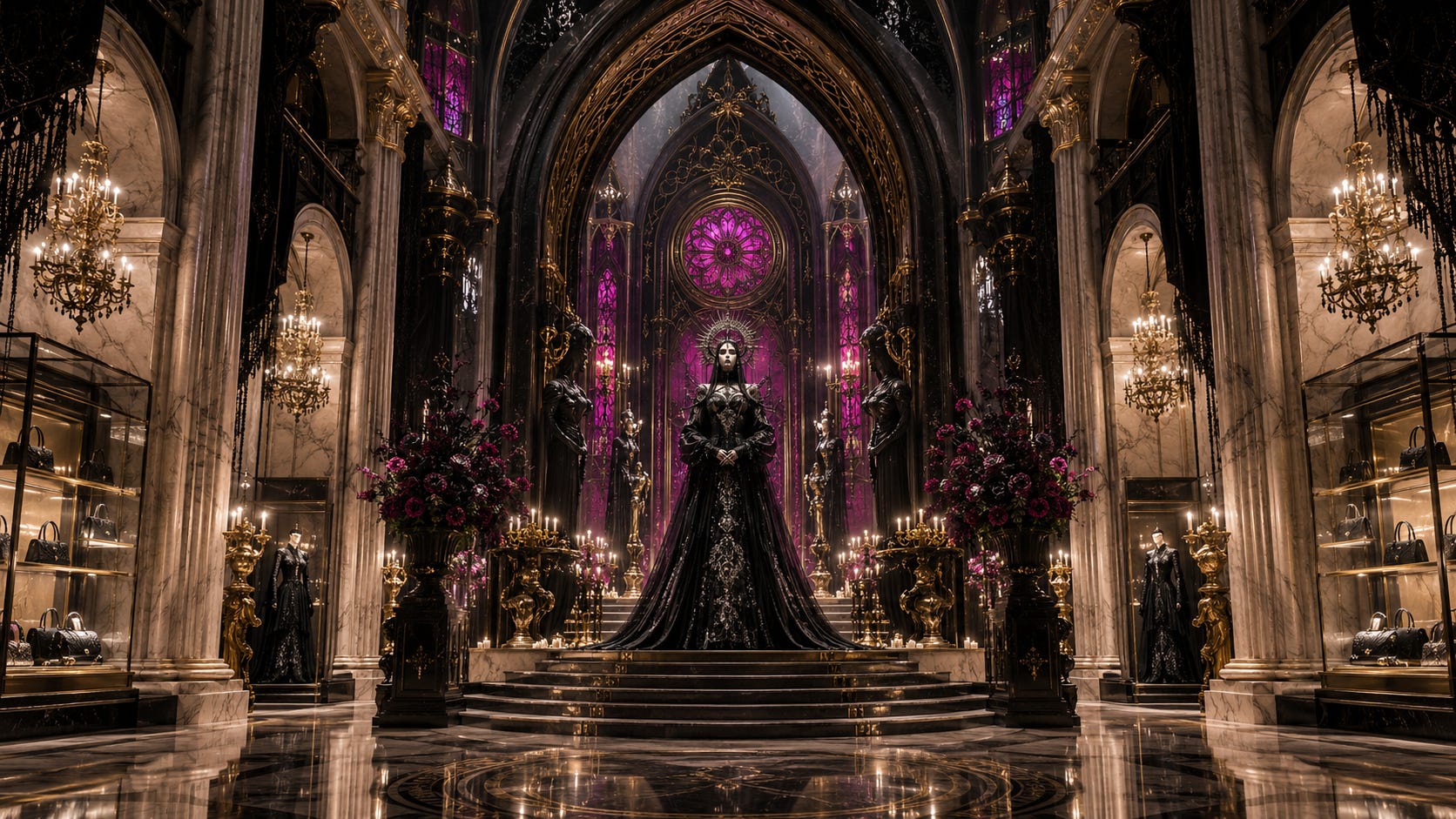
I. The Boutique Is a Temple Without a God
Enter the luxury boutique and one sees at once that commerce has studied religion more carefully than most priests have studied commerce. The door is guarded. The interior is quiet. Objects appear under glass. Light falls with theatrical caution. Staff speak in lowered tones. Every surface suggests that ordinary life has been suspended.
This is sacred architecture stripped for parts.
Mircea Eliade argued that sacred space is marked by rupture. It breaks the homogeneity of ordinary space and gives the worshiper an orienting center, an axis around which the world becomes ordered.1 The boutique mimics this rupture. It separates the customer from the street, then invites him into a consecrated enclosure where leather, silk, metal, and logo assume the posture of relics. The effect can be powerful. One should grant the devil his tailoring. He often cuts well.
Yet the boutique’s sacredness remains unstable because its center is commercial rather than metaphysical. The object has aura, but the aura depends on scarcity, price, campaign imagery, celebrity circulation, and the whispered approval of those who know how to read the code. Thorstein Veblen described conspicuous consumption as a public display of pecuniary strength, a ritual of rank through visible waste.2 The luxury house refines this practice until social aggression becomes velvet-soft. A handbag becomes a portable heraldic shield. The customer does not merely buy leather. He buys recognition disguised as taste.
Jean Baudrillard saw modern consumption as a system of signs, where objects are chosen for their place within a code.3 Luxury therefore becomes a language whose grammar is status. The boutique teaches the worshiper to say, “I belong among the consecrated.” Yet belonging bought through signs remains fragile. It must be renewed season after season, campaign after campaign, collection after collection. No altar should require quarterly earnings.
II. Goth Begins Where Prestige Ends
Goth begins at a lower, stranger, and holier point. It begins with the person who cannot enter the smooth social order without mutilating the soul. It begins with estrangement.
An outcast in black boots, a secondhand coat, pale makeup, a battered copy of Poe, and a room lit by one candle has already understood something that many bury under upholstery: modern life has no adequate ritual for sorrow. Society permits grief at funerals, clinical sadness in therapy, and cheerful resilience on social media. It leaves little room for the long majesty of melancholy. Goth takes that rejected material and builds an interior cathedral.
Paul Hodkinson’s study of goth subculture emphasizes the importance of shared style, music, identity, and communal practice in sustaining the scene.4 Goth is therefore more than clothing. It is a symbolic order, formed through repeated acts. Dress, sound, room, gathering, literature, and nightlife all become instruments of orientation. The goth does what sacred cultures have always done. He marks time. He marks space. He marks the body.
This is why goth can possess more spiritual gravity than luxury branding. It begins with a wound rather than a purchase. It does not ask first, “Who will admire me?” It asks, “What form can contain this darkness?” That question has theological density. Poe, Baudelaire, and Huysmans each understood, in different registers, that the beautiful can become most severe when it approaches decay.5 Goth inherits this severity and turns it into habit. A black coat becomes an answer to the unbearable lightness of cheap optimism.
III. Black Is the Color of Sacred Refusal
Black, in the goth vocabulary, is never mere absence. It is compression. It gathers grief, dignity, erotic distance, penitence, theatricality, mourning, and command into one field of force. Michel Pastoureau’s history of black shows the color’s long passage through authority, sin, elegance, austerity, death, and modern chic.6 Goth does not invent these meanings. It raids the ancestral treasury.
Black refuses the false innocence of the modern surface. It stands against the therapeutic pastel, the lifestyle beige, the corporate blue, the mall-white glare, and that peculiar shade of motivational orange that seems designed by a committee of people who fear silence. Black says that sorrow has rights. It says that death will be admitted into the room. It says that the soul need not dress like a software update.
The black garment also creates a threshold around the body. The wearer becomes marked. In older religious cultures, marked dress separated the monk, the mourner, the penitent, the priest, the widow, the knight, and the ruler. Clothing made inward commitments visible. Goth preserves this instinct in a democratized and imperfect form. It places the body under sign. It turns the self into a walking chapel of refusal.
Philippe Ariès showed how Western attitudes toward death changed across centuries, from public familiarity to modern concealment.7 Goth rebels against that concealment. It places death back in the visible order. Skulls, veils, lace, cemetery imagery, crosses, pallor, old churches, mourning silhouettes, and night scenes all say the forbidden thing: life is finite, beauty is mortal, and dignity begins when one stops pretending that death is a scheduling problem.
IV. Gucci Sells Status; Goth Creates Liturgy
The difference between Gucci and goth is the difference between status and liturgy.
Status depends upon recognition. It requires witnesses who understand the sign. Its power falters when the logo is unread, the object becomes outdated, or the room contains people with a higher code. Liturgy depends upon repetition. It forms the person through repeated action in a charged symbolic order. Catherine Bell argued that ritualization creates distinctions between ordinary acts and privileged acts, shaping bodies through patterned behavior.8 Goth, at its strongest, is ritualization through aesthetic discipline.
The preparation of the goth body is ceremonial. Clothing is selected with care. Makeup is applied as mask, icon, shield, and confession. Music establishes mood. Night becomes sacred time. The club becomes chapel by other means. The bedroom becomes a reliquary of chosen signs: records, candles, old books, black fabric, devotional images, dried flowers, tarnished metal, perhaps a mirror that looks as though it has seen a family curse and found it tasteful.
Luxury branding can imitate these signs, and often does. It can sell black lace, silver crosses, heavy boots, and mourning silhouettes at prices that would make a medieval abbot drop his quill into the soup. Yet imitation does not confer liturgy. A runway may display the signs of darkness. A subculture lives them through repetition, belonging, and risk. Goth requires the social cost of being legible as strange. That cost matters. Sacrifice has always been the grammar of sacred things.
V. The Gothic Cathedral Is the True Ancestor
The word “goth” reaches backward into architecture, literature, history, and fantasy before it reaches the dance floor. The modern goth is the descendant of pointed arches, ruins, graveyards, vaulting, stained glass, gargoyles, storm-lit towers, cloisters, crypts, and Catholic shadow. Its true ancestor is the Gothic cathedral, that immense machine for turning fear upward.
John Ruskin’s account of Gothic architecture in The Stones of Venice treats the Gothic as morally charged because it bears the marks of living labor, imperfection, and spiritual aspiration.9 He saw in Gothic workmanship a freedom absent from mechanical smoothness. A. W. N. Pugin, in his polemical defense of Christian architecture, treated Gothic form as the proper architectural expression of a Christian social order.10 The modern goth inherits fragments of both visions. It loves the vertical, the shadowed, the handmade, the ruined, the devotional, the severe.
A Gothic cathedral does not abolish darkness. It orders darkness toward light. It allows shadow to make radiance intelligible. Stained glass needs dimness. Candlelight needs stone. Incense needs enclosure. Chant needs echo. The entire building is a metaphysical argument against flatness.
Goth miniaturizes this argument. It brings the cathedral into the wardrobe, the bedroom, the photograph, the club, the song, and the face. The goth body becomes a small vaulted structure under the pressure of modern ugliness. This may sound excessive, but most modern interiors are designed as though the human soul were a conference attendee looking for bottled water. Excess has its uses when the age has become spiritually under-furnished.
VI. The Thrifted Velvet Coat as Relic
Consider the thrifted black velvet coat.
It may be worn at the cuff. Its lining may be frayed. It may smell faintly of dust, rain, old perfume, and the sorrow of previous owners. It has no glossy box, no sales associate, no guarded archive, no campaign budget. Yet it may carry more Material Truth than a pristine luxury accessory because it has passed through time.
Daniel Miller’s work on material culture insists that objects mediate social life and identity in ways far deeper than mere possession.11 The coat matters because it has entered use. It is chosen, altered, worn, repaired, carried through weather, photographed in bad light, and remembered. It becomes a witness. A luxury object often arrives with status preloaded. The goth object must be consecrated by wear.
William Morris argued that art should belong to the conditions of daily life, and he attacked the ugliness produced by industrial civilization with a ferocity that remains bracing.12 Ruskin likewise elevated the moral meaning of craft and the visible hand.13 The thrifted velvet coat participates in this older moral economy. Its beauty resides in texture, friction, weight, and relation to the body. It is imperfect in the manner of living things.
The boutique object asks to be protected from life. The goth relic asks to be brought deeper into it. One fears rain. The other improves under it.
VII. Gucci Is Luxury Without Death
The weakness of luxury branding is its terror of death. Death makes status absurd. The tomb has no VIP entrance. The skull has never paused before a receipt.
Goth begins with the skull.
This gives it authority. Memento mori traditions, vanitas painting, mourning jewelry, funeral dress, grave sculpture, and the ars moriendi literature of late medieval Christianity all recognized death as a clarifying presence.14 Death strips away decorative lies. It asks what can endure when admiration fails. A serious culture keeps death visible because death disciplines value.
Modern consumer culture hides death behind euphemism, medicine, screens, and administrative softness. People no longer die; they “pass.” Bodies vanish into systems. Mourning becomes brief, managed, and faintly embarrassing. The old black clothes disappear, the old rituals contract, and grief is expected to become tasteful before it has become intelligible. Beige chairs in hospital waiting rooms may be the clearest symbol of the age: death surrounded by washable fabric.
Goth restores the skull to the table. It refuses the exile of mortality. It says that a beautiful life must know its end, and that a beautiful object must speak under the shadow of that end. Gucci offers the fantasy of being admired before death. Goth offers the possibility of being beautiful in death’s presence.
VIII. The Creative Class as Accidental Priesthood
The goth subcreator is a minor priest of atmosphere.
The musician, tailor, photographer, illustrator, jeweler, DJ, club organizer, poet, zine-maker, set designer, and bedroom decorator all participate in the making of a secondary world. J. R. R. Tolkien’s theory of subcreation describes the human maker as one who forms coherent secondary worlds under the greater creative act of God.15 Goth, when serious, practices subcreation at the scale of a life.
A room becomes a world. A playlist becomes a calendar. A wardrobe becomes a rule. A club night becomes a feast day. A photograph becomes an icon. A handmade necklace becomes an amulet. The creative class earns its dignity precisely when it builds these worlds rather than feeding the content furnace. Content is the sawdust left after culture has been run through a machine. A world asks more from its makers. It demands coherence, recurrence, discipline, boundary, sacrifice, and taste.
This is why goth deserves defense from both sides: from the philistine who sees only costume, and from the marketer who sees only trend. Goth at its best, it is a school of sacred refusal. It teaches that sorrow can be formalized, that alienation can become craft, and that beauty grows more powerful when it stops begging the daylight for permission.
IX. The Sin of Gucci Is Weightlessness
The accusation against Gucci cannot be that it makes ugly things. Some luxury houses still produce objects of real craftsmanship. Some garments possess cut, weight, proportion, and daring. The sin is spiritual weightlessness.
Modern luxury too often operates through acceleration. Seasonal churn, celebrity spectacle, resale frenzy, social media visibility, and symbolic pricing pull the object away from craft and into circulation. Dana Thomas’s account of the luxury industry describes how many old houses became global businesses in which brand aura and scale changed the meaning of luxury itself.16 Once aura becomes managed at industrial scale, majesty begins to look suspiciously like a spreadsheet wearing sunglasses.
Weightlessness means that the object floats free of place, hand, ordeal, and death. It becomes a sign moving through The Maelstrom. The customer purchases distinction, yet distinction must be constantly refreshed because the sign decays faster than the material. The logo ages before the leather does. That is a terrible arrangement. Even bread has better metaphysics.
Goth restores weight. Heavy boots. Heavy coats. Heavy music. Heavy rooms. Heavy symbols. Heavy poetry. This weight matters because the anxious modern soul is constantly being lifted, scattered, agitated, and atomized. Weight returns the person to gravity. It says: stand here, dress this way, listen to this, remember death, keep the candle lit, repair the coat, enter the night with dignity.
X. The Black Chapel Must Be Built
The lesson is larger than goth, and larger than Gucci.
The soul needs a sacred center. Without one, it drifts into consumption, anxiety, imitation, and soft despair. Aesthetic discipline can rebuild that center because beauty teaches the body before doctrine reaches the mind. This is the secret known to churches, courts, old universities, guild halls, monasteries, and noble houses. Space forms desire. Objects train attention. Clothing instructs posture. Ritual gives time a spine.
The black chapel is therefore a principle before it is a style. Build a room with gravity. Choose objects that can suffer use. Keep one candle. Keep books with weight. Wear clothing that reminds the body it has dignity. Hang images that make cheapness feel ashamed. Allow death a visible place. Give sorrow form before it becomes poison. Refuse the rented sanctity of pure status.
Goth is holier than Gucci because holiness begins where purchase ends. The boutique can sell the mask of beauty, but the black chapel teaches beauty to suffer, kneel, rise, and sing. A thrifted velvet coat worn in fidelity to a world may outrank a luxury bag carried in obedience to a market. That judgment will scandalize the smooth and amuse the dead.
The dead have excellent taste. They have had time to think.
Bibliography
Ainsworth, Maryan W., ed. Petrus Christus: Renaissance Master of Bruges. New York: Metropolitan Museum of Art, 1994.
Ariès, Philippe. The Hour of Our Death. Translated by Helen Weaver. New York: Knopf, 1981.
Ariès, Philippe. Western Attitudes toward Death: From the Middle Ages to the Present. Translated by Patricia M. Ranum. Baltimore: Johns Hopkins University Press, 1974.
Baudelaire, Charles. Les Fleurs du mal. Paris: Poulet-Malassis et De Broise, 1857.
Baudrillard, Jean. The Consumer Society: Myths and Structures. Translated by Chris Turner. London: Sage, 1998.
Bell, Catherine. Ritual Theory, Ritual Practice. New York: Oxford University Press, 1992.
Eliade, Mircea. The Sacred and the Profane: The Nature of Religion. Translated by Willard R. Trask. New York: Harcourt, Brace & World, 1959.
Hodkinson, Paul. Goth: Identity, Style and Subculture. Oxford: Berg, 2002.
Huysmans, Joris-Karl. Against Nature. Translated by Margaret Mauldon. Oxford: Oxford University Press, 1998.
Miller, Daniel. Material Culture and Mass Consumption. Oxford: Basil Blackwell, 1987.
Morris, William. “The Lesser Arts.” In Hopes and Fears for Art: Five Lectures Delivered in Birmingham, London, and Nottingham, 1878–1881, 1–40. London: Ellis & White, 1882.
Pastoureau, Michel. Black: The History of a Color. Translated by Jody Gladding. Princeton, NJ: Princeton University Press, 2008.
Poe, Edgar Allan. “The Philosophy of Composition.” Graham’s Magazine 28, no. 4 (April 1846): 163–67.
Pugin, A. W. N. Contrasts: Or, A Parallel between the Noble Edifices of the Middle Ages and Corresponding Buildings of the Present Day. 2nd ed. London: Charles Dolman, 1841.
Ruskin, John. The Stones of Venice. Vol. 2, The Sea-Stories. London: Smith, Elder, and Co., 1853.
Thomas, Dana. Deluxe: How Luxury Lost Its Luster. New York: Penguin Press, 2007.
Tolkien, J. R. R. “On Fairy-Stories.” In The Monsters and the Critics and Other Essays, edited by Christopher Tolkien, 109–61. London: George Allen & Unwin, 1983.
Veblen, Thorstein. The Theory of the Leisure Class: An Economic Study of Institutions. New York: Macmillan, 1899.
Mircea Eliade, The Sacred and the Profane: The Nature of Religion, trans. Willard R. Trask (New York: Harcourt, Brace & World, 1959), 20–65.
Thorstein Veblen, The Theory of the Leisure Class: An Economic Study of Institutions (New York: Macmillan, 1899), 68–101.
Jean Baudrillard, The Consumer Society: Myths and Structures, trans. Chris Turner (London: Sage, 1998), 27–62.
Paul Hodkinson, Goth: Identity, Style and Subculture (Oxford: Berg, 2002), 9–35.
Edgar Allan Poe, “The Philosophy of Composition,” Graham’s Magazine 28, no. 4 (April 1846): 163–67; Charles Baudelaire, Les Fleurs du mal (Paris: Poulet-Malassis et De Broise, 1857); Joris-Karl Huysmans, Against Nature, trans. Margaret Mauldon (Oxford: Oxford University Press, 1998).
Michel Pastoureau, Black: The History of a Color, trans. Jody Gladding (Princeton, NJ: Princeton University Press, 2008), 85–170.
Philippe Ariès, Western Attitudes toward Death: From the Middle Ages to the Present, trans. Patricia M. Ranum (Baltimore: Johns Hopkins University Press, 1974), 1–25, 85–107.
Catherine Bell, Ritual Theory, Ritual Practice (New York: Oxford University Press, 1992), 74–117.
John Ruskin, The Stones of Venice, vol. 2, The Sea-Stories (London: Smith, Elder, and Co., 1853), 151–230.
A. W. N. Pugin, Contrasts: Or, A Parallel between the Noble Edifices of the Middle Ages and Corresponding Buildings of the Present Day, 2nd ed. (London: Charles Dolman, 1841), 1–20.
Daniel Miller, Material Culture and Mass Consumption (Oxford: Basil Blackwell, 1987), 19–82.
William Morris, “The Lesser Arts,” in Hopes and Fears for Art: Five Lectures Delivered in Birmingham, London, and Nottingham, 1878–1881 (London: Ellis & White, 1882), 1–40.
Ruskin, Stones of Venice, 2:151–230.
Philippe Ariès, The Hour of Our Death, trans. Helen Weaver (New York: Knopf, 1981), 107–83; Maryan W. Ainsworth, ed., Petrus Christus: Renaissance Master of Bruges (New York: Metropolitan Museum of Art, 1994), 169–75.
J. R. R. Tolkien, “On Fairy-Stories,” in The Monsters and the Critics and Other Essays, ed. Christopher Tolkien (London: George Allen & Unwin, 1983), 109–61.
Dana Thomas, Deluxe: How Luxury Lost Its Luster (New York: Penguin Press, 2007), 1–20, 221–44.
Hi Gene, Thanks for thinking of me and sharing your views. Good luck with the article!