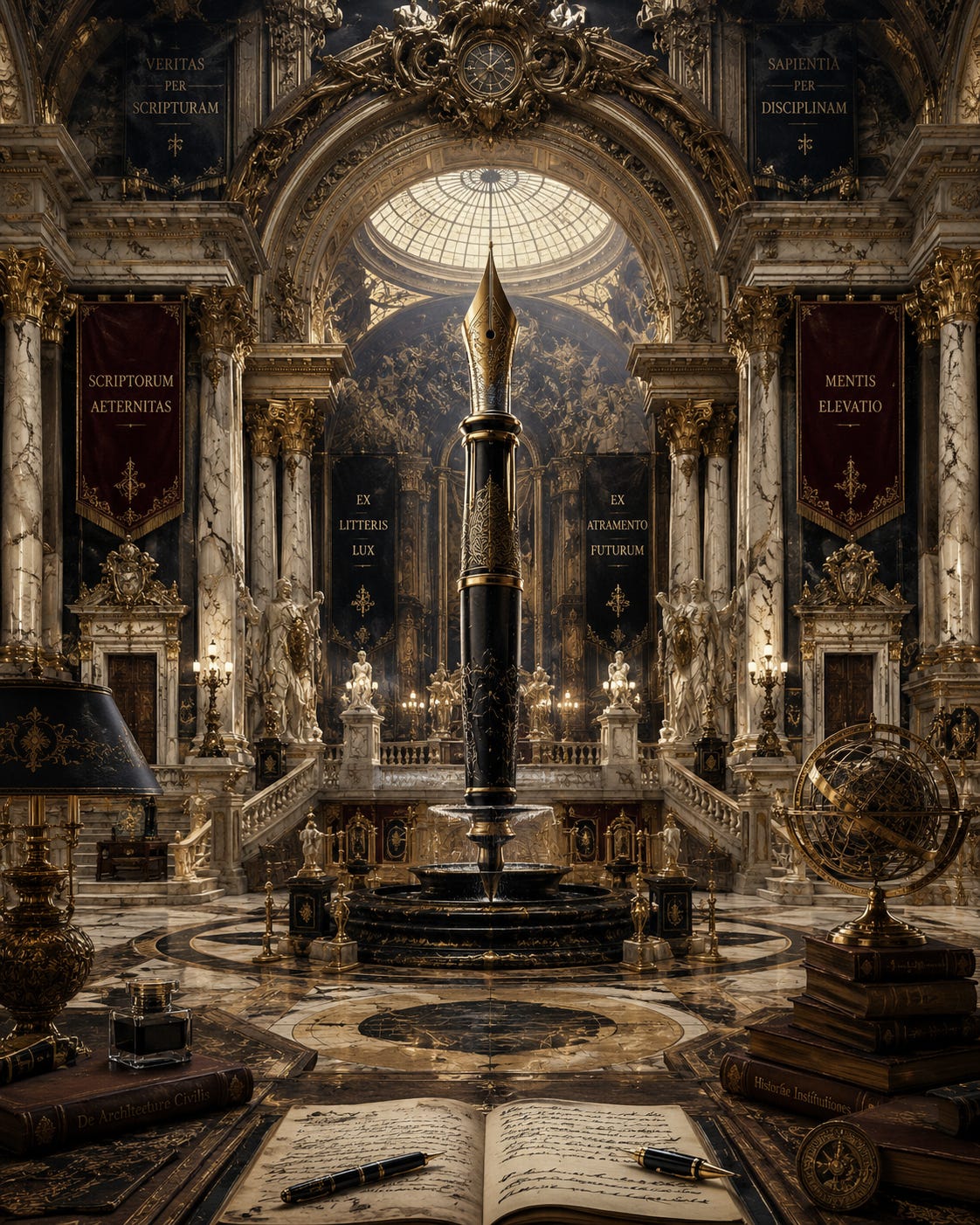
“Ink is thought accepting a body.”
The keyboard is useful, fast, and forgettable. It receives language with the moral seriousness of a vending machine accepting coins. Tap, tap, tap, delete, revise, vanish. The thought appears, changes costume, and flees before the mind can accuse it of cowardice.
The fountain pen refuses this little circus.
It demands pressure. It demands angle. It demands paper worthy of the mark. Hold it badly and the line protests. Rush it and the script becomes a nervous animal. Neglect it and the ink clots. The object has standards, which makes it nearly scandalous in an age where every tool arrives pre-forgiving and rubber-cornered.
Dark Academia understands the majesty of such difficulty. Its best instinct is reverence for the room where thought acquires atmosphere: the library desk, the green-shaded lamp, the worn oak chair, the wool coat left over the armrest, the book opened with something like obedience. The fountain pen belongs there because it makes intellect visible.
A ballpoint writes as if language were an errand. A fountain pen writes as if language were an oath.
This distinction matters. The student who writes with a fountain pen cannot pretend that knowledge is merely content. He must slow down. His hand must follow the sentence through its turns. Ink fixes hesitation, ambition, vanity, and discipline onto the page. There is no bright little backspace key waiting like a priest of cowardice. Error remains. The blot is a confession.
That is why the fountain pen is an artifact rather than a tool. It binds the writer to consequence. It says that thought deserves ceremony before it enters the world.
Modern education has tried to abolish this ceremony. It gives students disposable pens, glowing screens, plastic desks, and documents that hover in the ether like bureaucratic ghosts. Then it wonders why learning feels weightless. A civilization cannot train the soul with objects that look ready for a dentist’s waiting room.
The fountain pen brings gravity back.
Its nib is a small piece of architecture. Its ink chamber is hidden intention. Its body rests in the hand with the seriousness of a miniature scepter. To write with it is to accept membership in a lineage of ledgers, letters, marginalia, sermons, field notes, poems, contracts, and private vows. Not every sentence deserves permanence, of course. Most emails deserve a shallow grave and a tasteful shrub. Still, the pen teaches the higher rule: write as though someone may one day care.
Dark Academia often risks becoming costume without discipline, a theater of tweed and candlelight performed for a camera. The fountain pen saves it from decorative decay because it demands use. It asks for study, practice, maintenance, and patience. It will not reward the poser for arranging it beside a latte and pretending to have read Thucydides.
The pen must move.
Its greatness lies in that union of beauty and action. The hand forms the word. The word forms the mind. The mind, if properly chastened, begins to perceive order.
Here, then, is the rite: uncork the bottle, fill the chamber, touch nib to paper, and let thought become visible under pressure. The page receives the line. The line receives the soul. The scholar is judged by what remains after the ink dries.
Beauty is the language eternity speaks to time.