

The Venus of Willendorf is small enough to vanish inside a closed fist. She has no carved eyes, no mouth, and no feet capable of supporting her. Her breasts hang over a rounded belly. Her thighs meet beneath broad hips. Shallow grooves cover the bowed head, perhaps representing braided hair or a woven cap.
Her scale tells us how she was encountered.
She was held.
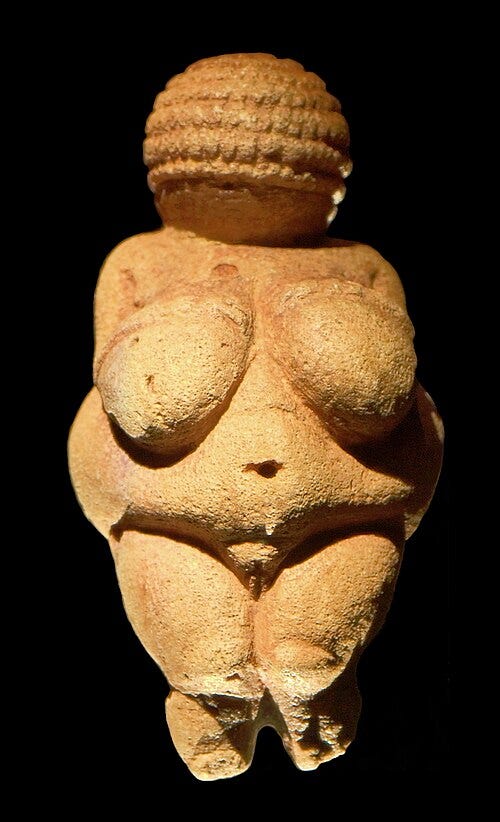
Unlike the animal painted deep inside a cave, this figure did not belong to one sacred location. She could travel with the people who carried her. A pouch became a chapel. A human hand supplied the pedestal.
That distinction places the Venus figurines among the earliest surviving forms of portable sacred art. As the Rogue Art Historian observes, prehistoric miniatures acquired meaning through movement. Their materials crossed considerable distances, while their surfaces collected the marks of handling. The object was part of life rather than a specimen waiting patiently for a museum to be built around it.
Portable art allowed sacred presence to accompany migration. A painted cave remained where the artist left it. A figure crossed rivers.
Abundance Was a Serious Matter
The Willendorf figure presents a body of extreme fullness. Modern interpretations usually begin with fertility, though that word has become soft through overuse.
Ice Age fertility was severe.
Pregnancy consumed strength. Birth carried mortal danger. Nursing depended upon the mother remaining fed while the group endured seasonal scarcity. A full body could signify stored time, bodily reserve, and the possibility that a child might survive.
The breasts and belly may therefore express abundance as a victory over death.
Anne Leader’s history of the figure interprets its anonymity as a movement away from individual portraiture. The sculptor emphasized the parts of the body connected with continuation, while the face and feet receded. She becomes less one woman than the female body understood as generative form.
Yet the familiar label of “fertility goddess” settles the question too quickly. Sayani Sarkar’s essay “Beyond the Venus Archetype” warns that the Venus category can flatten objects made across immense spans of time and territory. Similar bodily forms may have carried different meanings. Archaeological filing cabinets have a habit of turning resemblance into theology.
The figurines may have concerned pregnancy. They may also have expressed age, status, ancestry, or bodily protection. Their silence leaves room for competing interpretations, though it does not grant us permission to furnish prehistory with whichever religion happens to flatter the present.
The Face Is Missing for a Reason
The absence of facial features gives the Venus of Willendorf much of her force.
A face creates an individual. It invites recognition. This figure refuses that encounter.
The head receives careful treatment, yet no person emerges. The grooves may depict an elaborate textile covering, a possibility explored by Archaeolog in “What’s on the ‘Venus’ of Willendorf’s Head?”. If the pattern represents fiber work, then the sculpture may also preserve evidence of prehistoric clothing and technical skill.
The face could have been concealed because personal identity mattered less than bodily condition. The figure may represent the mother rather than a mother. She may contain an ancestral role without portraying a particular ancestor.
Her bowed posture also directs attention inward. She does not address the person holding her. She seems enclosed within her own body.
Pregnancy follows the same structure. A hidden life changes the visible body before its face can be known. The Venus holds that mystery in stone.
Stone Preserved What Flesh Could Not
A living body changes. The carved body remains.
Pregnancy ends. Breasts dry. Age alters the limbs. Death returns flesh to the earth. Limestone resists this rhythm.
The Willendorf figure never ceases to be full. Her body has been removed from ordinary biological time and fixed at the point of abundance.
Red ochre once intensified this effect. Pigment brought pale stone closer to flesh. Held near fire, the figure would have shifted under moving light. Grooves darkened. The belly caught the flame. The little body may have appeared almost alive.
Prehistoric art repeatedly used ochre to turn material into charged form. Maria C. J.’s discussion of misconceptions surrounding prehistoric art challenges the old picture of early makers as crude people stumbling toward representation. The selection and preparation of pigment required knowledge. So did carving. “Primitive” becomes a convenient word when the speaker would prefer not to admit that someone thirty thousand years ago knew exactly what he was doing.
The maker did more than copy a woman.
The maker drew a durable body from stone.
Religion Before the Temple
Sacred art did not begin as decoration for established religious buildings. The image came first. Architecture followed much later.
Michael Sugrue’s essay “Because Someone Asked” treats prehistoric art as evidence of human consciousness moving beyond immediate sensation into symbolic form. A creature capable of making an image can hold something absent before the mind. It can preserve a fear, embody a hope, and give an unseen power a visible boundary.
The Venus figurine performs precisely this work.
Fertility becomes weight.
Continuity receives a body.
A power associated with birth can be touched even when no birth is taking place.
This symbolic act does not require a developed goddess with a biography and priesthood. Ritual may have preceded formal theology. Gabriela Gutierrez’s essay “When the Gods Walked Among Us” places prehistoric religion within ordinary domestic life. The sacred did not always occupy a separate chamber. It remained near food, sleep, illness, and childbirth.
A portable figure fits that world perfectly. It crosses the boundary modern people draw between sacred rite and daily necessity, probably because the boundary had not yet acquired a fence.
The Modern Venus
The figure now sits behind glass.
Her movement has ended. Her surface may no longer be touched. A thing shaped for intimacy has become a public monument to distance.
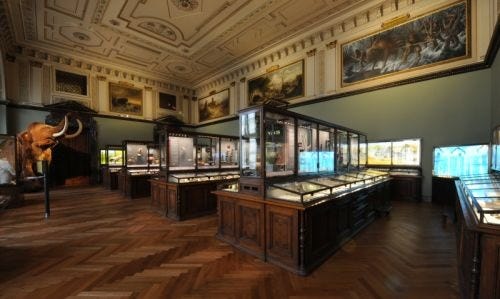
Modern culture has also given her new meanings. She appears as a symbol of body acceptance, motherhood, matriarchal religion, and female creative power. The recent Art Xchange essay “The Woman They Called Venus” examines how the classical name imposed a later theory of beauty and fertility upon a much older object.
These modern readings may reveal genuine needs. They reveal less about Paleolithic Europe than their advocates sometimes claim.
The figure’s greatness lies partly in her resistance.
She reminds us that sacred objects once belonged to gestures we cannot recover. Someone knew when she should be held. Someone knew whether she belonged near birth or burial. Someone may have spoken her name.
The name disappeared.
The gesture survived.
A human being shaped the female body from stone, colored it red, and made it small enough to carry through winter. The first sacred architecture may have stood inside a closed hand.


