

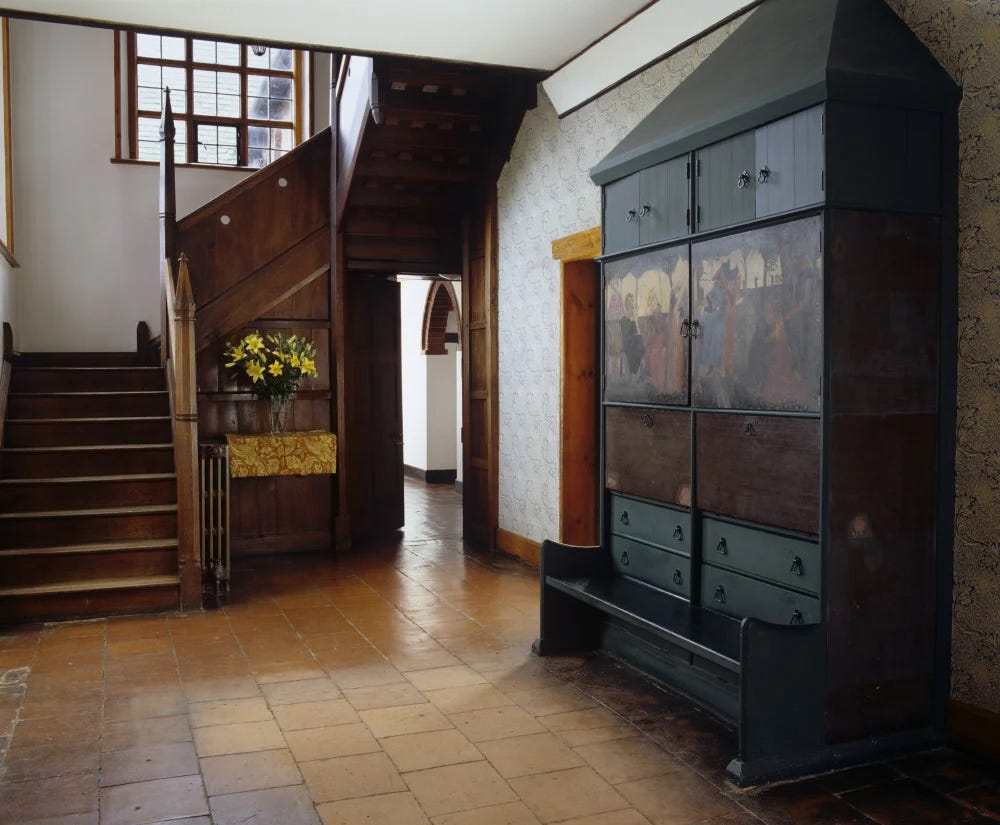
The walls of William Morris’s Red House are made of plain red brick. They possess none of the pale classical polish expected of a respectable Victorian residence. The roof rises sharply. Chimneys interrupt the skyline. Arches, painted furniture, stained glass, embroidered fabrics, and medieval scenes draw the rooms together until the house begins to feel like an artifact recovered from another England.
Morris commissioned the house from his friend Philip Webb shortly after marrying Jane Burden. Completed in 1860, it became the gathering place of the artistic circle surrounding the Pre-Raphaelites. Edward Burne-Jones contributed paintings and stained glass. Jane Morris and her sister Elizabeth Burden worked on embroidery. Friends painted walls and designed furnishings. The garden was planned as the outermost room, clothing the house in orchard trees, roses, and seasonal growth.
The National Trust describes Red House as medieval in spirit and calls it the birthplace of the decorative style that became Morris & Co. That description is true, although it sounds rather mild once one has grasped the scale of Morris’s ambition. Red House was an argument built from brick, timber, pigment, wool, friendship, and domestic ritual. It proposed that England could awaken from industrial ugliness by recovering the unity of art and life.
Morris did more than decorate a house. He gathered the fragments of a broken story and taught them to recognize one another.
His experiment raises a question much larger than interior design. Can an artistic movement create a new metanarrative? Can artists give a people a coherent account of their origins, duties, trials, and destiny? Can a shared style become a shared world?
It can. Yet the movement must become something much greater than a collection of images. It must recover an inheritance, embody a sacred order, form a brotherhood, secure patronage, enter ordinary life, and train successors. A recognizable aesthetic may sell prints. A metanarrative teaches a people where they stand in history and what they owe to the future.
The modern artist is encouraged to express himself. The civilizational artist accepts a sterner commission: he must give visible form to a world that others can inhabit.
I. Every People Lives Inside a Story
A society survives by locating its members within a past they inherit and a future they owe to others.
Stand before the portal of a medieval cathedral. Creation appears in stone. Prophets rise along the jambs. Kings, apostles, angels, beasts, virtues, vices, and scenes of judgment cover the entrance. Before the worshipper hears a sermon, the doorway has placed him inside an account of reality.
He knows that the world was created rather than assembled by accident. He knows that history possesses direction. He sees that human actions receive judgment, that kings stand beneath divine authority, that monsters violate an order they did not create, and that sanctity represents the proper end of human life. The entrance tells him what sort of world he is entering because it tells him what sort of world he already inhabits.
This is what a metanarrative does. It answers the questions which procedural society tries to bury beneath paperwork. Who are we? Where did we come from? What wounded the world? What must we preserve? What must we overcome? What will happen if we remain faithful? What becomes of us if we forget?
Every civilization answers these questions, even when it claims to have outgrown them. A society that denies sacred history will interpret itself through another story: economic liberation, technological conquest, racial struggle, sexual emancipation, endless personal choice, or the gradual abolition of inherited limits. The public creed may deny the existence of creeds. This merely gives its priests an amusing pronunciation problem.
Mircea Eliade argued that religious man experiences space as ordered around sacred centers. Certain places disclose a higher reality and orient the surrounding world. In The Sacred and the Profane, he contrasts this experience with the uniformity of profane space, in which one place becomes exchangeable with another. A useful summary of Eliade’s account of sacred space explains that sacred man seeks a fixed point from which the world receives direction.
A metanarrative performs the same work within time. It gives history a center. Birth, marriage, work, death, war, pilgrimage, harvest, and burial enter a larger pattern. A man can endure sacrifice because he understands where sacrifice belongs. He can inherit because he knows what an ancestor is. He can build because the future contains people toward whom he has duties.
When that story disappears, public life becomes administrative. Rules remain. Forms remain. Buildings remain. Meaning quietly leaves through the service entrance.
An artistic movement begins creating a metanarrative when it restores orientation. It takes the scattered experiences of a people and places them within a sacred history. Its first duty is therefore coherence. Its art must reveal how human life belongs within creation, inheritance, judgment, and eternity.
II. The Artist Gives the Story a Body
A metanarrative remains an abstraction until artists teach people what it looks, sounds, and feels like.
Enter Giotto’s Arena Chapel in Padua. An azure ceiling covered with golden stars stretches above the room. Along the walls, painted scenes recount the lives of the Virgin and Christ. The sequence moves from Joachim’s expulsion from the Temple through the Annunciation, Nativity, Passion, Resurrection, and final judgment. Vice and virtue appear beneath the sacred history, making moral choice part of the same order.
The chapel surrounds the viewer with a story. One does not encounter a single religious image extracted from its setting. One stands within an account of salvation. Architecture becomes narrative space. Color becomes theology. The body of the worshipper moves beneath the stars while biblical history unfolds at human height.
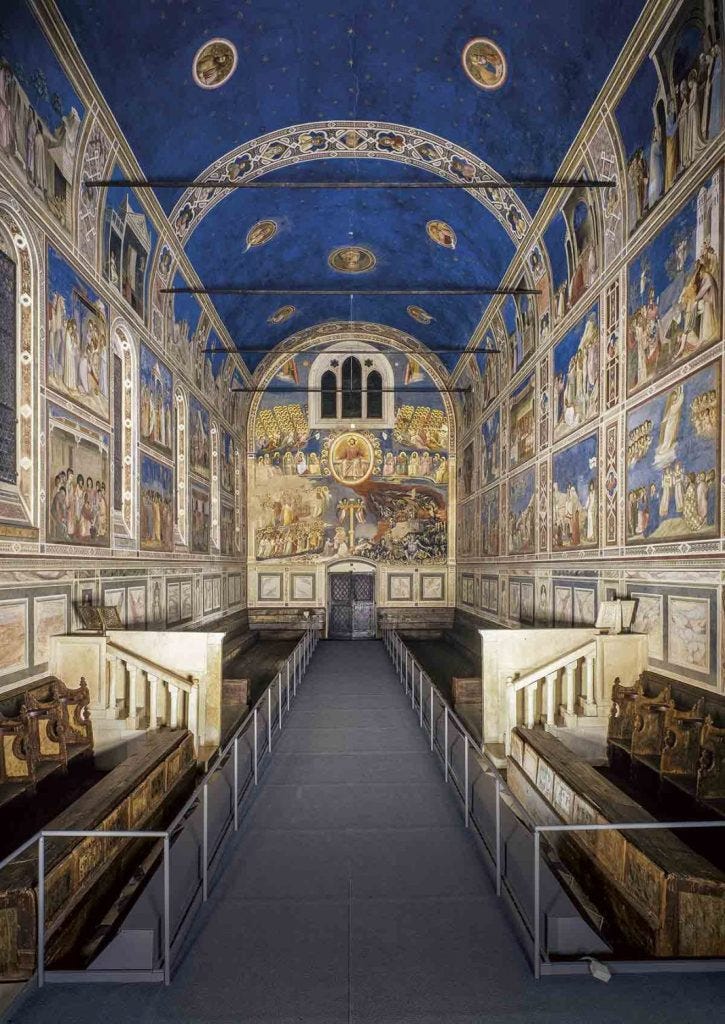
The digital survey of the Scrovegni Chapel shows how Giotto joined the lives of Mary and Christ to the Last Judgment within one painted enclosure. The chapel is frequently praised for the emotional force and naturalism of its figures. Its deeper achievement lies in the unity of the whole. Grief, betrayal, mercy, birth, death, and glory all belong to the same cosmos.
Artists make metanarratives perceptible through recurring forms. Colors acquire moral associations. Heroes embody virtues. Monsters reveal the borders of order. Landscapes become ancestral territory. Music teaches the body when to mourn, feast, march, and kneel. Architecture distinguishes the sacred center from the ordinary road.
This work demands far more than assembling attractive symbols. Symbols must belong to one another. The saint, sword, rose, ruin, crown, forest, and star require a common story if they are to carry anything beyond atmosphere. Otherwise, one has a remarkably handsome drawer of loose buttons.
J.R.R. Tolkien understood this problem with rare clarity. In “On Fairy-Stories,” he described fantasy as sub-creation: the making of a secondary world possessing an “inner consistency of reality.” The Tolkien Estate’s discussion of the essay identifies sub-creation as the heart of his artistic thought. Tolkien’s secondary world works because language, geography, genealogy, kingship, corruption, providence, death, and sacrifice emerge from one deep order.
Middle-earth feels discovered because it contains evidence of ages that preceded the immediate plot. Roads lead toward ruined kingdoms. Songs preserve memories imperfectly. Names carry forgotten histories. Swords descend through lineages. The landscape itself has suffered. Characters enter a story already underway, much as every human being enters a family, nation, and faith whose beginnings he did not witness.
That is the difference between assembling lore and making myth. Lore provides information about a fictional place. Myth places the reader inside a morally charged history.
Artists seeking to create a shared metanarrative must practice symbolic continuity. They should choose a disciplined vocabulary of forms, virtues, figures, places, materials, and conflicts, then develop it across many works. A movement that replaces its central symbols whenever fashion shifts possesses a brand package rather than a sacred world.
III. Great Movements Recover Before They Create
New cultural stories gain authority by awakening something older than their authors.
The Pre-Raphaelite Brotherhood began in 1848 as a secret circle of young artists and one writer. Its early members opposed the conventions taught by the Royal Academy and sought a return to the sincerity, clarity, and close attention to nature they associated with art before Raphael. The small initials “PRB” appeared on their paintings before the public knew what they meant.
The Metropolitan Museum of Art describes their founding purpose as a marriage of artistic renewal and moral reform, pursued through seriousness, sincerity, and truth to nature. Medieval poetry, Arthurian legend, biblical history, Italian painting, English landscape, and botanical exactness flowed together in their work. They did not treat the past as a cabinet of costumes. They treated it as an interrupted inheritance.
This distinction matters. Empty nostalgia copies the surface of an older age because the surface photographs well. Recovery asks what truth the form once carried.
A Gothic arch once ordered weight, light, procession, and sacred attention. A modern imitation glued above a television carries a thinner burden. A medieval garment belonged to rank, climate, labor, ceremony, and local production. Its polyester descendant belongs to a shopping cart and, after one crowded convention, perhaps to a landfill. The resemblance may be sincere. The cultural structure has vanished.
The Pre-Raphaelites and their Arts and Crafts descendants sought to restore the bond between beauty, work, morality, and social life. The Yale Center for British Art characterizes their project as a radical artistic and social vision inspired by the preindustrial past. Their medievalism judged the present. It exposed the poverty of industrial labor, commercial ugliness, and mass-produced goods.
Morris made this argument directly. In his lecture “Art Under Plutocracy”, he refused to separate the condition of art from the condition of labor. Bad work produced bad surroundings because the degradation of the maker entered the object. Beauty could not remain the privilege of galleries while ordinary people spent their lives manufacturing ugliness.
Tolkien recovered in the same manner. His work draws upon Germanic legend, Christian cosmology, philology, medieval kingship, and the English countryside. These materials were neither copied intact nor dissolved into private fantasy. They were brought into a new relationship that revealed their enduring power.
The civilizational artist therefore studies before he declares. He learns folklore, liturgy, regional architecture, sacred art, old songs, local materials, family histories, traditional crafts, and the names once given to the surrounding land. He searches for fragments whose meaning has survived their social setting.
The aim is fidelity without servile imitation. A new metanarrative must sound ancient at its roots and present in its judgment. It should recognize the inheritance, then answer the wound of its own age.
IV. A Shared Story Requires a Brotherhood
Isolated artists produce works; disciplined circles produce schools.
The letters “PRB” meant more than friendship among painters. They represented common principles, declared standards, shared sources, mutual criticism, and a desired renewal of English art. Members quarreled, changed, failed, married disastrously, and behaved like artists who had been allowed indoors. Yet their circle generated far more than any one member could have produced alone.
A coherent artistic world requires complementary vocations. Painters provide faces. Poets give the world speech. Architects shape movement through space. Composers give public feeling a rhythm. Craftsmen carry symbols into ordinary objects. Publishers preserve thought. Teachers form judgment. Theologians distinguish sacred meaning from aesthetic intoxication. Patrons purchase the material and time from which durable work is made.
Historical cultures built structures for this cooperation. Workshops joined masters to apprentices. Guilds governed training and quality. Monasteries preserved texts, music, images, gardens, and patterns of prayer. Courts gathered poets, painters, architects, and musicians around dynastic memory. Salons introduced writers to patrons and critics. Small journals allowed artistic circles to state their principles before the public.
Modern creators often possess audiences without colleagues. Their work reaches thousands while they remain alone in rented rooms, answering comments from strangers who have names like “GraveyardPrince873.” Reach does not produce a school. Shared labor does.
A contemporary movement should begin with a small circle organized around study and finished work. Its members should read common sources, learn complementary crafts, declare standards, and subject their work to criticism. They should publish essays, exhibit finished pieces, commission one another, and hold physical gatherings. Membership should depend upon contribution. An aesthetic community composed entirely of spectators soon becomes a dress code with refreshments.
The circle also needs hierarchy. Masters should be recognized because they have mastered something. Apprentices should accept instruction because admiration without obedience produces flattering stagnation. Standards must exist outside personal affection. If every attempt is praised, praise becomes wallpaper: pleasant from a distance, repetitive upon inspection.
The cultural structure worth building is a local school, atelier, choir, workshop, journal, or guild capable of training successors. A movement becomes historically serious when it can reproduce its standards in people who never met the founders.
V. The Patron Determines Which World Receives Stone
Artists tell the story, but patrons decide whether it receives timber, paper, pigment, and time.
The Arena Chapel bears the name of the Scrovegni family because Enrico Scrovegni commissioned it. Whatever mixture of devotion, family reputation, penitence, and civic ambition lay behind the project, wealth became painted theology. Giotto’s vision required walls, scaffolding, assistants, pigments, and months of concentrated labor. Mystical blue has an invoice somewhere behind it.
Artists often speak of patronage with embarrassment, as if art becomes impure once money crosses the room. This is an oddly modern conceit. Every cathedral kept accounts. Manuscripts required animal skins, gold leaf, pigments, candles, meals, and sheltered hours. Choirs require training. Buildings require land. The question concerns the purpose toward which wealth is directed.
Bad patronage rewards spectacle, ideological obedience, commercial familiarity, or personal vanity. Good patronage places resources behind work meant to become an inheritance.
The medieval Church, Renaissance court, civic republic, aristocratic household, and craft guild each supported art through a different structure. Each also imposed demands. The artist was expected to serve a liturgical, dynastic, civic, or moral purpose larger than personal disclosure. Constraints could produce conflict and bad work. They also gave art public consequence.
The modern platform offers another patronage system, although it prefers to conceal the arrangement. It rewards the image that arrests attention for a few seconds, provokes immediate reaction, and resembles work that has already succeeded. A human patron can ask whether a painting will teach generations how to understand sacrifice. A platform consults a graph designed by men who appear never to have entered a beautiful room.
Any movement seeking to build a metanarrative must cultivate patrons alongside artists. Local patronage circles can commission murals, icons, books, furnishings, gardens, festivals, music, architectural ornament, and sacred objects. A parish could commission a cycle of images from local artists rather than ordering generic prints. A family could employ a craftsman to make a table intended for inheritance. A neighborhood association could fund a carved memorial that gives local grief a permanent place.
Patrons should fund connected bodies of work rather than isolated products. In return, artists must accept duty, judgment, deadlines, and the possibility that another person’s needs matter. Patronage creates obligation on both sides. That obligation rescues art from the lonely monarchy of self-expression.
VI. Ritual Turns Art into Common Memory
People begin to inhabit a metanarrative when they repeat it together.
A religious procession changes the meaning of a street. Icons, banners, candles, bells, incense, vestments, and song pass through space normally surrendered to traffic and commerce. The road becomes a sacred route. Familiar buildings become stations. Neighbors become witnesses. The town briefly recognizes that it exists beneath a heaven absent from its zoning maps.
Stories endure because communities repeat them through time. Feasts recall deliverance. Fasts discipline desire. Funerals place private grief within ancestral continuity. Pilgrimages turn geography into moral memory. Festivals bind seasons to founding events. Repetition sinks meaning into the body.
An artistic movement confined to images cannot establish a metanarrative with much force. People may admire its visual language, purchase its objects, and adopt its colors while remaining untouched by its account of life. A sacred world becomes habitable through recurring action.
Richard Wagner understood this. His concept of the Gesamtkunstwerk gathered music, poetry, drama, costume, architecture, and myth into a total work. Bayreuth extended the artistic event beyond the score. Wagner pursued a dedicated theater, a recurring festival, and an audience gathered for a shared encounter with myth. The Bayreuth Festival’s own history records how the festival became the enduring home of his major stage works.
Wagner’s achievement also reveals the danger. Total art can acquire liturgical force. Once music, symbol, architecture, darkness, costume, and collective attention converge, the audience becomes susceptible to something closer to ritual than entertainment. The truth of the story then becomes more important. Beauty magnifies whatever it serves.
A worthy artistic movement should create occasions ordered toward remembrance: seasonal festivals, dramatic cycles, sacred concerts, public readings, pilgrimages, craft fairs, exhibitions arranged as journeys, communal meals, and rites of mourning. These acts should emerge from the movement’s central history and virtues. A festival needs a reason to return each year beyond vendor availability.
The calendar is one of the artist’s greatest neglected materials. Whoever orders the feast days orders memory.
VII. A Metanarrative Forms a Particular Kind of Person
The worth of a sacred world appears in the character it teaches people to admire.
Consider an icon of Saint George. The saint sits upright upon his horse. His spear descends toward the dragon. A rescued figure waits nearby. Heaven opens above. The image presents courage as service, evil as real, victory as obedience, and strength as something answerable to divine order.
The icon does more than depict an event. It proposes a human type.
Every aesthetic does this. Advertising forms consumers trained in appetite. Celebrity culture forms spectators trained in imitation. Bureaucratic architecture forms occupants prepared for impersonality. Luxury marketing forms people who mistake expense for distinction. Much contemporary art trains its audience to admire transgression long after the surrounding culture has begun awarding grants for it. The rebel has acquired a pension plan.
A metanarrative must answer a simple and severe question: what kind of person does this story teach us to love?
Its heroes disclose its moral center. What do they owe their ancestors? What do they preserve when preservation becomes costly? How do they use power? What do they refuse? How do they respond to beauty, suffering, betrayal, authority, and death? What will they sacrifice for people who cannot repay them?
A movement founded entirely upon rebellion cannot answer these questions for long. It defines its members through an enemy. Once that enemy weakens, the movement must invent fresh offenses to preserve its identity. Rebellion becomes a machine that consumes the very conditions of its own drama.
Durable metanarratives offer a positive account of greatness. They portray holiness, courage, fidelity, craftsmanship, hospitality, restraint, and sacrifice as forms of human splendor. They teach that hierarchy entails duty, that inheritance entails stewardship, and that beauty entails responsibility.
For a Christian artist, the final measure lies in the Incarnation. The sacred enters matter. Divinity does not despise the body, history, craft, food, blood, water, wood, oil, bread, wine, or the human face. Christian art gives visible form to creation restored through Christ. Its symbols refer beyond themselves because matter has become capable of bearing glory.
Tolkien came close to this principle when he wrote of the Gospel as the supreme fairy story entering primary history. In “On Fairy-Stories”, he argued that the Christian story possesses the wonder and joy of fairy tale while claiming historical truth. Sub-creation reaches its proper order when human making reflects divine Creation rather than competing with it.
The artist who seeks to form a people must therefore ask what his work teaches them to worship. Every sacred world has a throne, even when the throne is disguised as a mirror.
VIII. The Story Must Enter Ordinary Life
A metanarrative becomes credible when it can design a chair, educate a child, and bury the dead.
Morris understood that civilization appears in small objects. A chair reveals what a culture thinks about labor, rest, material, dignity, and duration. A wallpaper pattern reveals whether nature has been studied or reduced to decoration. A book reveals whether reading is treated as an encounter or a transfer of information.
Red House mattered because its vision governed the entire room. Architecture, furniture, embroidery, painting, stained glass, books, garden, hospitality, and friendship answered one another. The National Trust’s account of the house notes that its hand-decorated interiors were made through collaboration with Morris’s Pre-Raphaelite circle. It was a household shaped by a school of art before that school possessed a factory, showroom, or historical label.
This is how an aesthetic crosses from subculture into culture. Its principles enter homes, schools, churches, workshops, streets, books, clothing, ceremonies, gardens, and public buildings. It develops what modern museums call the decorative arts and what healthier societies understood as the ordinary presence of beauty.
Contemporary subcultures often purchase the appearance of worlds they lack the skills to build. Gothic culture buys plastic tracery, resin gargoyles, printed tapestries, and mass-produced furniture assembled beneath fluorescent lights. Cottagecore imports synthetic pastoralism through a logistics chain that would make a village blacksmith seek the wilderness. The desire is real. The craft structure remains absent.
The path forward begins with mastery. An artist studies stone carving, woodwork, iconography, bookbinding, textile design, ceramics, typography, metalwork, gardening, mural painting, or sacred music. A household commissions local work. A parish supports apprentices. A publisher gives its books a visual language worthy of their contents. A town restores a neglected building without stripping it of every regional peculiarity.
The point is to make the story tangible. Children should encounter it in books made for them. Families should handle it at the table. Worshippers should see it in church. Workers should practice it through honorable materials and useful objects. The dead should be buried beneath symbols that tell the living what death means.
A movement becomes culture when its sacred story can survive a Tuesday afternoon.
IX. The Story Must Answer the Ruins of the Present
A living metanarrative speaks to inherited wounds rather than decorating an escape hatch.
Walk through an abandoned shopping mall. The fountain is dry. Plastic foliage gathers dust beneath a skylight. Blank storefronts face an empty corridor. Outside, acres of parking lot hold the faded geometry of a promised abundance.
The building once offered a complete story. Happiness came through acquisition. Social life occurred around consumption. Novelty arrived each season. Identity could be purchased, revised, and purchased again. The mall has declined, yet the story survives on smaller glowing screens carried in every pocket.
A new artistic movement must answer the wounds left by that world: uprootedness, ugly housing, degraded labor, cultural amnesia, digital abstraction, loneliness, and the disappearance of sacred time. Medieval imagery alone will not accomplish this. A painted knight cannot repair social trust by looking stern above a sofa.
Morris’s medievalism mattered because it judged industrial Britain. His beautiful rooms exposed ugly factories. His textiles raised questions about the dignity of work. His romances presented fellowship against commercial calculation. His “Useful Work versus Useless Toil” connected the quality of labor with the quality of the life it produced.
Tolkien’s Shire performs a similar function. It portrays household, locality, inherited custom, modest property, cultivated land, hospitality, and resistance to mechanized domination. Its charm sharpens the horror of Saruman’s mills. The reader returns from Middle-earth with a greater ability to recognize desecration at home.
This is one of the highest purposes of the secondary world. It cleanses perception. By showing an ordered world elsewhere, it exposes disorder here.
Artists should name the central wound their movement seeks to heal. They must then show how their story changes labor, housing, education, worship, friendship, courtship, burial, and public space. If the movement can explain its preferred color palette yet cannot explain how its members ought to treat neighbors, it has stopped several floors below metanarrative.
The sacred world must offer an entrance back into reality.
X. From Artistic Movement to Inherited World
The movement succeeds when its founders become less important than the tradition they leave behind.
Return to Red House. Its painted walls and heavy furniture retain the marks of Morris, Webb, Burne-Jones, Jane Morris, and their circle. Yet the house has outgrown biography. It stands as evidence that a group of friends once tried to inhabit a story about England, labor, beauty, nature, domestic life, and the medieval inheritance.
They began with a house because a house is where an idea faces its first severe test. A manifesto may ignore weather, money, children, meals, guests, exhaustion, storage, and the regrettable dimensions of actual chairs. A house cannot.
An artistic movement can create a metanarrative when it gathers inherited truths into a coherent account of origin and destiny, gives that account visible form, establishes a symbolic language, creates disciplined circles, secures patronage, orders a calendar, forms admirable human types, enters ordinary life, and answers the suffering of its age.
The work begins on a human scale. A few artists gather around common sources. They name the story they believe their people have forgotten. They recover its ancestors. They define its virtues and recognize its enemies. They learn the crafts required to give it form. Patrons commission complete works. Families place those works inside daily life. Festivals return each year. Apprentices become masters. Children inherit symbols whose founders’ names they may never learn.
The test is transmission. A personal style dies with the person or becomes a museum category. A metanarrative passes into buildings, songs, rituals, habits, objects, and memory. It supplies people with a world they did not invent alone and cannot exhaust through private interpretation.
Begin with one room in which the whole vision can be seen. Design the furniture. Paint the walls. choose the books. Establish the symbols. Serve the meal. Gather the circle. Tell the story. Make each part answer to the same sacred center.
Then build another room.
The grand worlds we love cannot remain trapped behind gallery glass, between book covers, or on the other side of a screen. Artists have spent long enough depicting lost worlds. Their greater task is to make one habitable.
A grand world awaits.


