


I. The Jacket Behind Glass
Every successful rebellion eventually meets a curator.
A black leather jacket rests inside the Metropolitan Museum of Art. Designed by Vivienne Westwood and Malcolm McLaren between 1980 and 1982, it carries the familiar grammar of punk: hard leather, metal fittings, plastic ornament, aggressive lines. Once, such a garment announced that its wearer stood outside respectable society. Today it has an accession number.
The museum did nothing improper by acquiring it. Westwood possessed genuine talent, and punk altered the visual language of fashion. Yet the glass case completes a curious journey. A garment made to disturb public order becomes an artifact maintained by climate control. The rebel enters the archive, where no one is permitted to touch him.
Leather supplied punk with an inherited vocabulary before punk painted its first slogan. It belonged to soldiers, aviators, motorcyclists, laborers, and men who expected their clothing to survive abrasion. The material acquired authority through use. Scratches proved that the wearer had gone somewhere. Repairs became a biography written in thread.
Punk borrowed this authority and added its own devices: safety pins, studs, chains, band patches, obscene phrases, painted emblems. The jacket became a portable wall upon which the wearer recorded loyalties and enemies. Its ugliness could be deliberate, though it was rarely careless. The best examples required selection, arrangement, handwork, and time.
That distinction matters. A jacket assembled over five years by someone who attended the concerts, knew the musicians, painted the lettering, and repaired the seams was a social document. A factory-made imitation arrived with the memories already printed on it. One garment recorded a life. The other supplied a receipt.
The Met’s collection preserves this contradiction. Its Westwood “Punkature” cardigan combined patchwork, hand-dyed canvas, metal, and domestic sewing techniques. The work drew strength from the friction between amateur damage and serious construction. Westwood would later produce pieces of rigorous tailoring and dressmaking, proving that transgression could mature into mastery.
The jacket behind glass therefore asks a harder question than whether punk was authentic. What happens after rebellion succeeds in making its symbols visible? Once everyone can recognize the uniform, anyone can manufacture it.
The market is an attentive undertaker. It waits politely for the movement to stop breathing, measures the corpse, and releases the spring collection.
II. Rebellion Is a Doorway, Not a Dwelling
Refusal can clear the ground. It cannot build the house.
A young person enters a suburban shopping center and discovers that nearly every object was designed to offend no one. The floor shines without beauty. The music possesses rhythm without danger. The clothing has been softened into seasonal units. Even the fake plants appear weary of the arrangement.
His rejection may contain sound judgment.
The modern goth, punk, metalhead, or romantic often begins with a genuine perception: ordinary public life has been deprived of ceremony, tragedy, majesty, and death. Buildings no longer teach reverence. Clothing rarely marks occasion or duty. Popular music is expected to accompany shopping, exercise, commuting, and dental work with equal obedience. The result is a culture that provides constant stimulation while inspiring very little wonder.
Rebellion names the absence. Black clothing restores visible mourning. Heavy music restores danger. Ruins restore historical depth. Incense, candles, bells, veils, masks, and processional movement recover fragments of ritual. Even adolescent theatricality may carry a serious intuition. The child dressing like a ghost has sometimes noticed that his society refuses to speak with its dead.
Yet negation cannot provide a lasting artistic principle. Opposition tells us what to reject, while leaving the object of love undefined. A movement organized around enemies must keep discovering fresh enemies. Once the surrounding culture adopts yesterday’s transgressions, the rebel must either become stranger or admit that he wants something more substantial than shock.
William Morris faced a similar choice. He despised the ugliness produced by industrial capitalism, though he did not remain seated before the factory gate composing complaints. He designed books, textiles, wallpaper, furniture, stained glass, and interiors. His disgust passed through the hand and became an object.
In “The Lesser Arts,” Morris described the two duties of decoration:
“To give people pleasure in the things they must perforce USE.”
He joined this with pleasure in making. Beauty belonged to daily labor, household objects, and common surroundings. Art was never meant to hover above life as an expensive apology for everything beneath it.
His account of real art began with work itself:
“Real art is the expression by man of his pleasure in labour.”
This is the point at which many contemporary subcultures fail. They inherit Morris’s disgust and misplace his loom. They can identify a hideous apartment, a cheap garment, a dead church, or a corporate entertainment product. Far fewer can produce the chair, coat, chapel, poem, or play that should replace it.
The path out begins with material questions. What buildings should this aesthetic erect? What ceremonies should it maintain? What skills should its children learn? Which objects should be repaired rather than discarded? What form of beauty deserves obedience?
A movement unable to answer remains attached to the culture it despises. It lives by pulling against the chain, which means the chain still chooses its direction.
III. The Market Learns the Costume
Commerce needs the visible signs of rebellion and very little else.
Every subculture produces a recognizable surface. Goth has black lace, silver jewelry, pointed arches, funerary flowers, pale faces, and candlelit rooms. Punk has leather, torn cloth, safety pins, crude lettering, and industrial debris. Cyberpunk has neon, prosthetics, rain, circuitry, corporate towers, and synthetic bodies. Cottagecore has linen, wildflowers, bread, ceramics, and cottages mysteriously free of property taxes.
These surfaces arise from deeper conditions. Gothic form carries the memory of medieval Christianity, Romantic literature, mourning customs, ecclesiastical architecture, and the sublime. Punk drew upon economic frustration, working-class dress, Dada, Situationism, underground music, and handmade publishing. Cyberpunk emerged from anxieties concerning corporate power, artificial intelligence, surveillance, urban decay, and the invasion of the human body by machinery.
The merchant can discard the genealogy. A crucifix, chain, black rose, and raven supply sufficient recognition for a “gothic” product. A circuit pattern and a strip of magenta light produce cyberpunk. The entire metaphysical burden is reduced to surface clues.
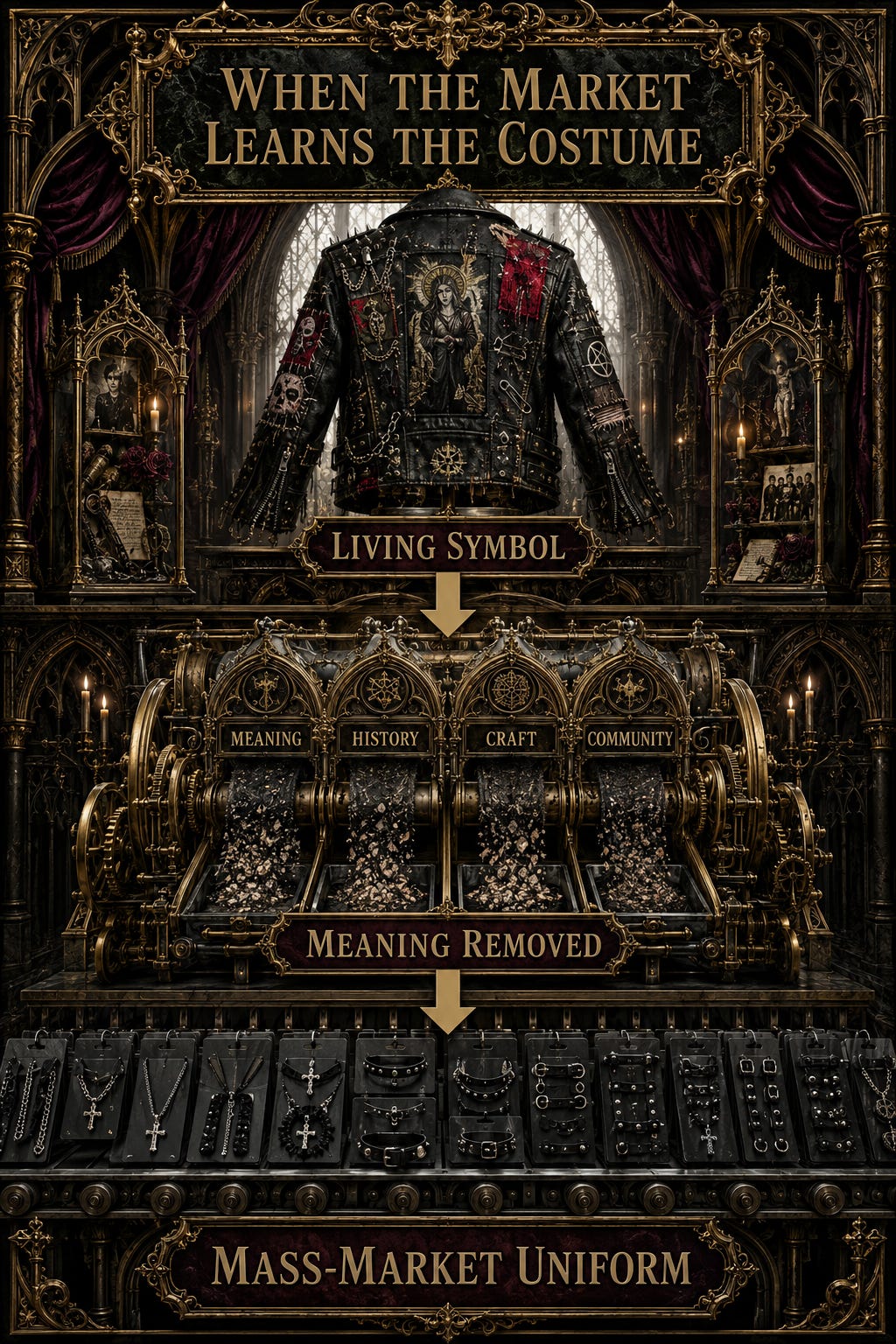
This reduction thrives on social platforms because images must announce themselves at thumbnail size. A subtle silhouette disappears. Fine joinery goes unrewarded. A carefully studied symbol cannot compete with a large crescent moon pasted above a bed. The camera favors the loud buckle over the well-cut sleeve. It has the taste of a magpie employed by a department store.
Punk itself entered this machinery early. Westwood and McLaren’s clothing shop helped establish the British punk look during the 1970s, and designers soon carried punk devices into mainstream fashion. The Met’s 1976 shirt retailed through SEX and Seditionaries now sits inside the Costume Institute. The border between cultural revolt and commercial design was present from the beginning.
Commercial exchange does not automatically corrupt art. Artists require food, workshops, tools, buildings, publishers, buyers, and patrons. The trouble begins when market recognition becomes the chief standard. At that point, the maker selects whichever symbols produce instant classification. The object says “goth,” “punk,” or “witch” before it says anything true.
Morris warned that beauty could not be reserved for a narrow category called fine art. In “The Arts and Crafts of Today,” he insisted:
“To apply art to useful wares…is a part of the serious business of life.”
A subculture seeking permanence must recover material honesty. Leather should behave like leather. Wood should reveal grain and joinery. Stone should carry weight. Linen should crease. Metal should acquire a patina. Ornament should clarify structure and meaning.
Plastic can imitate the appearance of age. It cannot inherit anything.
IV. Approved Transgression Is Still Conformity
The rebel becomes tame when everyone knows which rules he is permitted to break.
Modern commercial culture is comfortable with rebellion when the rebellion arrives in familiar packaging. The approved dissident may dye his hair, wear bondage trousers, mock inherited religion, praise every fashionable political cause, and adopt theatrical despair. He looks dangerous in a manner immediately legible to advertisers, university administrators, streaming services, and human-resources departments.
The costume declares revolt. The opinions often reveal remarkable obedience.
Subcultures create internal scripts because every community needs boundaries. Members learn which musicians deserve reverence, which garments count as authentic, which historical periods may be romanticized, and which tastes bring expulsion. Since these hierarchies are seldom admitted, they operate through insinuation, ridicule, follower counts, and private denunciation.
The person who entered seeking freedom discovers another etiquette manual, though this edition has bats printed in the margins.
The error lies in pretending that hierarchy can be abolished. Every artistic circle distinguishes better from worse. Someone has more skill. Someone knows more history. Someone has better judgment. When formal standards disappear, concealed standards take their place. Technical mastery gives way to social fluency. The finest artist may lose to the person most skilled at repeating the room’s approved grievances.
Earlier artistic societies often acknowledged rank openly. The medieval workshop distinguished master, journeyman, and apprentice. Court dress revealed office and station. The liturgy assigns different vestments and actions to priest, deacon, chanter, reader, and layman. Such arrangements can be corrupted, though their visibility permits judgment. Hidden rank behaves like mildew beneath wallpaper. Everyone smells it; polite people insist the wall is dry.
A serious subculture should judge work according to intelligible standards. Does the garment fit? Does the building stand? Does the composition direct the eye? Does the symbol belong to the subject? Does the poem contain music, structure, and memorable language? Has the artist mastered the inherited form before altering it?
The Met describes Westwood’s later work through the productive tension between tradition and transgression. That tension explains her importance. She learned enough about tailoring to violate its expectations with purpose. Rebellion gained force from the order it opposed because she understood that order from within.
A poor painting does not become excellent because its message irritates the correct people. It becomes an ugly political pamphlet with a frame.
V. Costume Without Craft Produces Dependence
If every emblem must be purchased, the rebellion belongs to the merchant.
The decisive question for any subculture is brutally simple: what can its members make?
A person may own twenty gothic outfits and remain dependent upon distant factories for every visible sign of his identity. He may fill a room with medieval motifs while knowing nothing of carving, weaving, metalwork, masonry, manuscript illumination, or stained glass. His taste may be sincere. His surrounding world still belongs to whoever controls the catalogue.
When the market changes, the objects disappear. When quality falls, buyers accept thinner fabric and weaker construction. When fashion discovers a new audience, symbols are redesigned to suit it. The consumer can complain, though complaint seldom repairs a seam.
A living tradition survives through trained hands. Tailoring allows a silhouette to persist after the retailer abandons it. Bookbinding carries a literary culture beyond the lifespan of a platform. Metalwork gives religious and subcultural emblems physical dignity. Typography shapes the voice of journals and manifestos. Furniture making creates rooms that embody the aesthetic rather than rooms decorated with its merchandise.
Morris looked back to periods when craft remained part of ordinary life. In his account of ancient and medieval art, he observed:
“All people who made anything shared in art.”
The statement does not mean every old spoon was a masterpiece. It means beauty had entered the common disciplines of making. The carpenter, mason, embroiderer, smith, potter, and scribe participated in a shared language of form. Their work filled streets, houses, churches, markets, and graves.
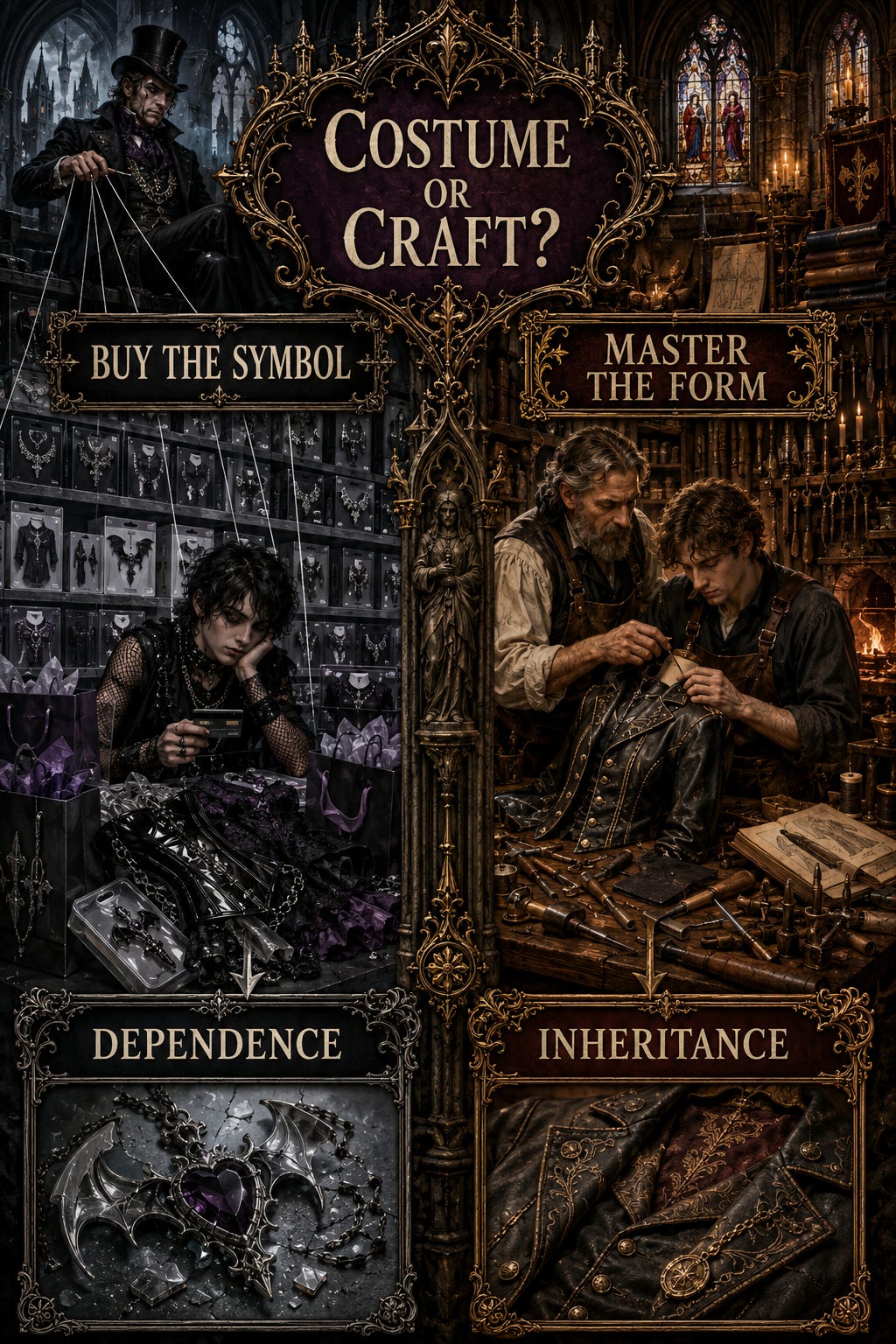
Modern subcultures already contain the beginnings of such an order. Independent designers make clothing to individual measurements. Leatherworkers produce belts and bags meant to age. Perfumers study incense, resins, soil, flowers, and smoke. Musicians recover analog instruments, choral forms, pipe organs, and unusual tuning systems. Publishers return to stitched bindings and illustrated editions.
These efforts need a common structure. A local circle might select one craft for a year, invite an experienced maker, study historical examples, share tools, criticize completed pieces, and exhibit the strongest work. The finished objects could be sold to finance the next round of training. Patrons could commission work for churches, homes, clubs, stages, and public gatherings.
Such a circle would give its members something more demanding than belonging. It would give them duties.
VI. The Sacred Cannot Survive as Decoration
Symbols with no altar eventually become wallpaper.
A gothic room may contain crucifixes, candles, incense, veils, icons, reliquary forms, funerary flowers, and pointed arches. Nearly every powerful object in the room descends from religion. Remove the Christian inheritance and the surviving aesthetic becomes strangely weightless. Death remains, yet resurrection disappears. Angels remain, stripped of divine service. The cross remains, separated from sacrifice. Incense remains, though no prayer rises with it.
The modern consumer wants sacred atmosphere without sacred order. He wants the cathedral’s shadows without the Creed recited inside it. This arrangement can produce beautiful photographs. It cannot sustain the symbols forever.
Sacred art receives its meaning from worship, doctrine, and communal memory. The Orthodox icon provides the clearest example. According to the Orthodox Church in America’s explanation of church imagery, the iconostasis reveals the unity of the worshipping Church with Christ, the Theotokos, the angels, and the saints. The icons belong to a liturgical body.
“It exists to show our unity with God.”
An icon is therefore more than a religious painting placed in a church. Its materials, figures, gestures, inscriptions, colors, and placement serve a received theological purpose. The image participates in prayer. Its beauty points beyond the personality of the painter.
Orthodox teaching concerning iconoclasm rests upon the Incarnation. As the OCA’s historical account explains, Christ may be depicted because His human nature is inseparably joined to His divine Person. Matter can bear holy meaning because God truly entered material creation.
This gives sacred art a gravity that aesthetic borrowing cannot reproduce. An icon of the Nativity contains a dark cave that signifies more than an attractive black shape. An Orthodox reflection on the Nativity image describes the cave as an abyss within the fallen world. Christ enters that darkness and changes its meaning.
A black shape on a panel becomes theology through form.
The same principle should govern the recovery of symbols within modern subcultures. Artists who borrow the crucifix should study the Crucifixion. Those who borrow mourning customs should learn how Christians prayed for the dead. Those who use angels should encounter beings whom Orthodox iconography represents as soldiers and “holy bodiless powers”, rather than pale fashion models with wings attached for the photograph.
The sacred demands symbolic accountability. One should know which door one has opened before rearranging the furniture inside the sanctuary.
VII. From Scene to School
A subculture acquires a future when it teaches more than recognition.
A scene gathers people around shared taste. They attend the same performances, wear related clothing, frequent the same venues, and recognize the same references. This can produce friendship, romance, artistic exchange, and the rare pleasure of entering a room where no one asks why you are dressed for a nineteenth-century funeral.
Yet a scene lives from event to event. When the venue closes, the musicians age, the rent rises, or the audience disperses, little remains beyond photographs and stories.
A school possesses another kind of memory. It transmits methods. It trains successors. It preserves models. It criticizes weak work and recognizes excellence. Its members may disagree fiercely because they share enough principles for disagreement to matter.
The Pre-Raphaelite Brotherhood became more than a circle of unusually well-haired young men because its members studied early Italian painting, published ideas, developed techniques, secured patrons, and produced a recognizable body of work. Morris & Co. joined medieval revival to workshops and commercial production. The Arts and Crafts movement spread through houses, furnishings, printing, textiles, gardens, and guilds.
Their lesson concerns structure. A lasting aesthetic needs teachers, apprentices, critics, patrons, archives, publications, exhibitions, ceremonies, and rooms in which people regularly meet. Affection helps. Affection cannot straighten a crooked hem.
Morris understood the problem as one of transmission. In “The Revival of Architecture,” he asked how people deprived of artistic traditions could recover the eyes needed to see:
“How shall we give people without traditions of art eyes with which to see?”
The answer begins with disciplined attention. Students should copy worthy forms, examine materials closely, visit buildings in person, read primary texts, and learn from living craftsmen. They should submit their work to criticism before displaying it for sale. Patrons should commission pieces whose demands exceed the artist’s habits. Publications should explain standards rather than flatter every contributor.
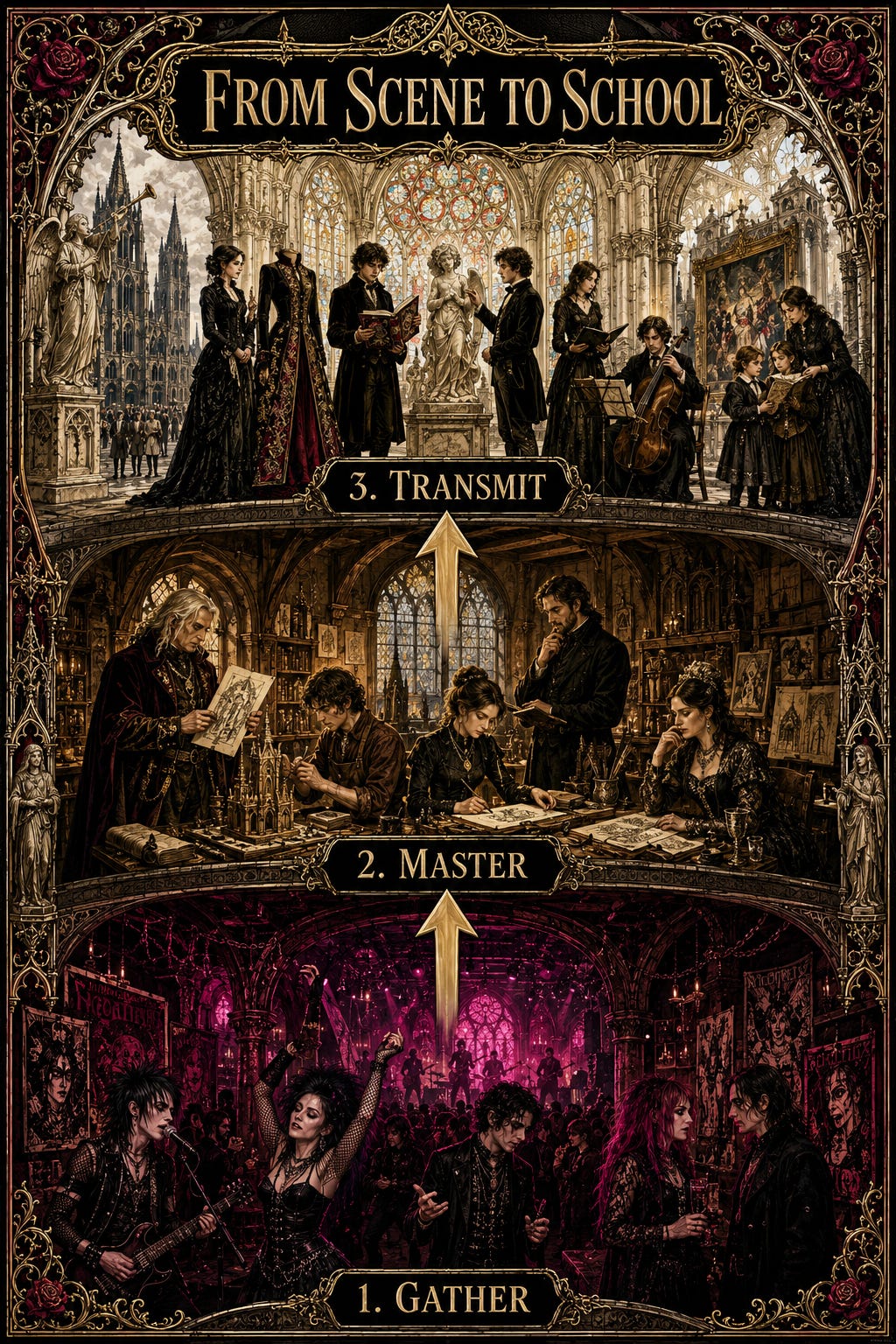
A Grand Aesthete house could gather three kinds of people. Students would study history and technique. Makers would produce work judged by knowledgeable peers. Patrons would fund commissions, tools, exhibitions, and apprenticeships. Membership would carry deadlines and obligations. Otherwise the guild becomes a group chat wearing a velvet cape.
The aim would be a body of work that can outlive its founders: garments built to be repaired, books made for inheritance, music written for real spaces, furnishings shaped for particular homes, sacred art produced for worship, and public ceremonies repeated until children remember them.
Then the subculture begins to become a culture.
VIII. The Garment Becomes a Vestment
The mature aesthetic clothes a people for duty, memory, and worship.
Return to the leather jacket in the museum.
Suppose its patches recorded actual places, friendships, losses, performances, vows, and achievements. Suppose its repairs revealed decades of use. Suppose its maker was known and its methods could be taught. Suppose the owner passed it to an apprentice who added another carefully made emblem.
The jacket would carry more than style. It would bear an office within a community.
Costume helps a person appear as something. Vestment places him within a duty. A priest’s vestments belong to the liturgy. A soldier’s uniform belongs to service and command. A craftsman’s apron belongs to work. A mourner’s black clothing belongs to grief, memory, and respect for the dead.
The subcultural uniform becomes culturally serious when it acquires comparable obligations. The person wearing it should belong to something more substantial than an audience demographic. His symbols should disclose loyalties. His taste should lead toward study. His admiration should sustain artists. His complaints about ugliness should end in a workshop.
Rebellion performs its noblest task when it rescues people from a dishonest and degraded order. It becomes sterile when refusal settles into permanent identity. The rebel who never learns to govern his taste remains a dependent of whatever he opposes.
Morris saw art as a common inheritance bound to work, pleasure, and daily surroundings. Orthodox Christianity gives the argument its final measure. Beauty reaches its fullness when it discloses the proper order of creation and directs love toward its true object. Sacred form disciplines the artist because the world did not begin with his personality.
The museum case should open.
Let the jacket leave the glass and enter a workshop. Place beside it the hide, shears, needles, awls, metal fittings, old pattern books, and unfinished garment of an apprentice. Let the artifact cease to be evidence of a vanished scene. Let it become the first lesson of a school.
A grand world awaits.


