


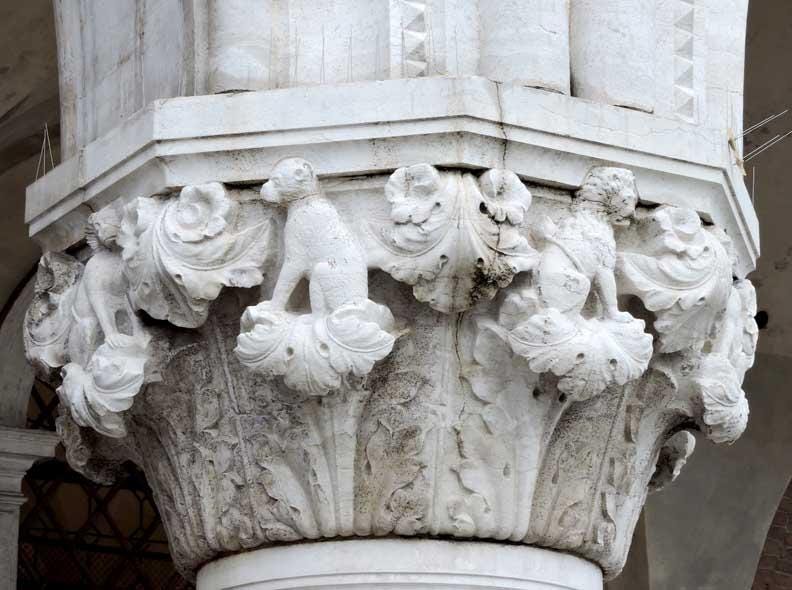
The leaf curls out from the capital as though it grew there by accident.
It is carved in pale stone, high upon a Venetian building, where generations of salt air have softened its edges. One side rises more sharply than the other. The veins wander. Its companion leaf bends in another direction entirely, while a small creature crouches among the foliage with the startled expression of an animal that has recently learned about property taxes.
No respectable machine would make such a thing. A machine would correct the imbalance, regularize the spacing, and repeat the approved design until the entire façade marched in spotless formation.
John Ruskin preferred the crooked leaf.
He did not prefer it because he lacked standards. Few critics have ever examined a building with more ferocious attention. Ruskin could spend pages judging the curve of an arch, the treatment of a cornice, or the moral implications of a carved cabbage. He preferred the irregular carving because its imperfections revealed that a person had made it. The marks left in the stone recorded a meeting among human judgment, inherited form, resistant material, and the particular temperament of one craftsman.
This was the deeper argument of “The Nature of Gothic,” the famous chapter from the second volume of The Stones of Venice. Gothic architecture mattered because it gave visible form to a social order in which the common workman retained some freedom to think. The cathedral possessed a governing design, a hierarchy of masters and apprentices, and an exact religious purpose. Within that order, the individual carver could still vary a leaf, invent a beast, or give one stone saint the face of somebody who had irritated him at supper.
The resulting building carried the fingerprints of an entire people.
Our buildings are smoother now. So are our tables, picture frames, coffee mugs, lamps, shoes, screens, and faces. We have gained astonishing powers of duplication while losing the visible evidence that anyone cared enough to make a particular object for a particular place.
Ruskin’s crooked carving can help us recover what disappeared.
I. The Crooked Leaf
Perfection can conceal the disappearance of the person who made the object.
Ruskin identified six qualities of Gothic architecture: savageness, changefulness, naturalism, grotesqueness, rigidity, and redundance. He was describing more than pointed arches and elaborate stonework. He was reading the moral character of a society through the things it built.
“Savageness” referred partly to the rough character of Northern Gothic work. The medieval carver lacked the polished technical refinement associated with classical sculpture. His human figures might be stiff. His animals could be anatomically improbable. His foliage did not always obey the reassuring laws of botany. Yet the carving remained alive because the worker had been allowed to place something of himself inside it.
Ruskin considered this liberty inseparable from imperfection. If a master demands flawless execution from every subordinate, he must either restrict them to tasks too simple to fail or reduce their work to mechanical obedience. A lesser craftsman who receives room to judge will sometimes judge poorly. His chisel may slip. His leaf may sag. His angel may look as though heaven accepted him after several appeals.
Ruskin accepted that danger because the alternative was spiritual mutilation.
“You must either make a tool of the creature, or a man of him.”
That sentence contains the heart of Ruskin’s social criticism. A worker may be trained, corrected, disciplined, and placed under authority. Yet he must retain some capacity to understand the whole work and exercise judgment within it. When every decision has been made elsewhere, the worker becomes an instrument through which another person’s mind operates.
The Gothic cathedral allowed degrees of ability to appear upon its surface. The master carved with mastery. The apprentice carved with promise. The ordinary mason contributed work that might be rough, earnest, and occasionally peculiar. Their differences became part of the building’s character.
This did not amount to an early doctrine of artistic self-expression. The carver did not arrive at the cathedral workshop announcing that his truth demanded a forty-foot stone monument to his moods. He received a tradition. He learned its proportions, subjects, tools, symbols, and standards. His liberty existed inside obedience.
That distinction matters. Ruskin’s defense of imperfection provides no sanctuary for laziness. A crooked carving produced through carelessness remains careless. A crooked carving produced by a trained hand responding sincerely to material and form may possess more life than a flawless copy.
One records neglect. The other records effort.
The modern eye often struggles to tell the difference because it has been trained by manufactured surfaces. We associate quality with regularity. Every seam should disappear. Every edge should be straight. Every unit should resemble every other unit so completely that the replacement can arrive from a warehouse two years later and fit without complaint.
Ruskin saw another standard. The object should reveal the intelligence, limitations, and affection of its maker. Its surface should bear witness to labor rather than conceal labor beneath synthetic perfection.
The crooked leaf is the craftsman’s fingerprint in the stone.
II. The Cathedral and the Factory
The shape of an object records the social order under which it was made.
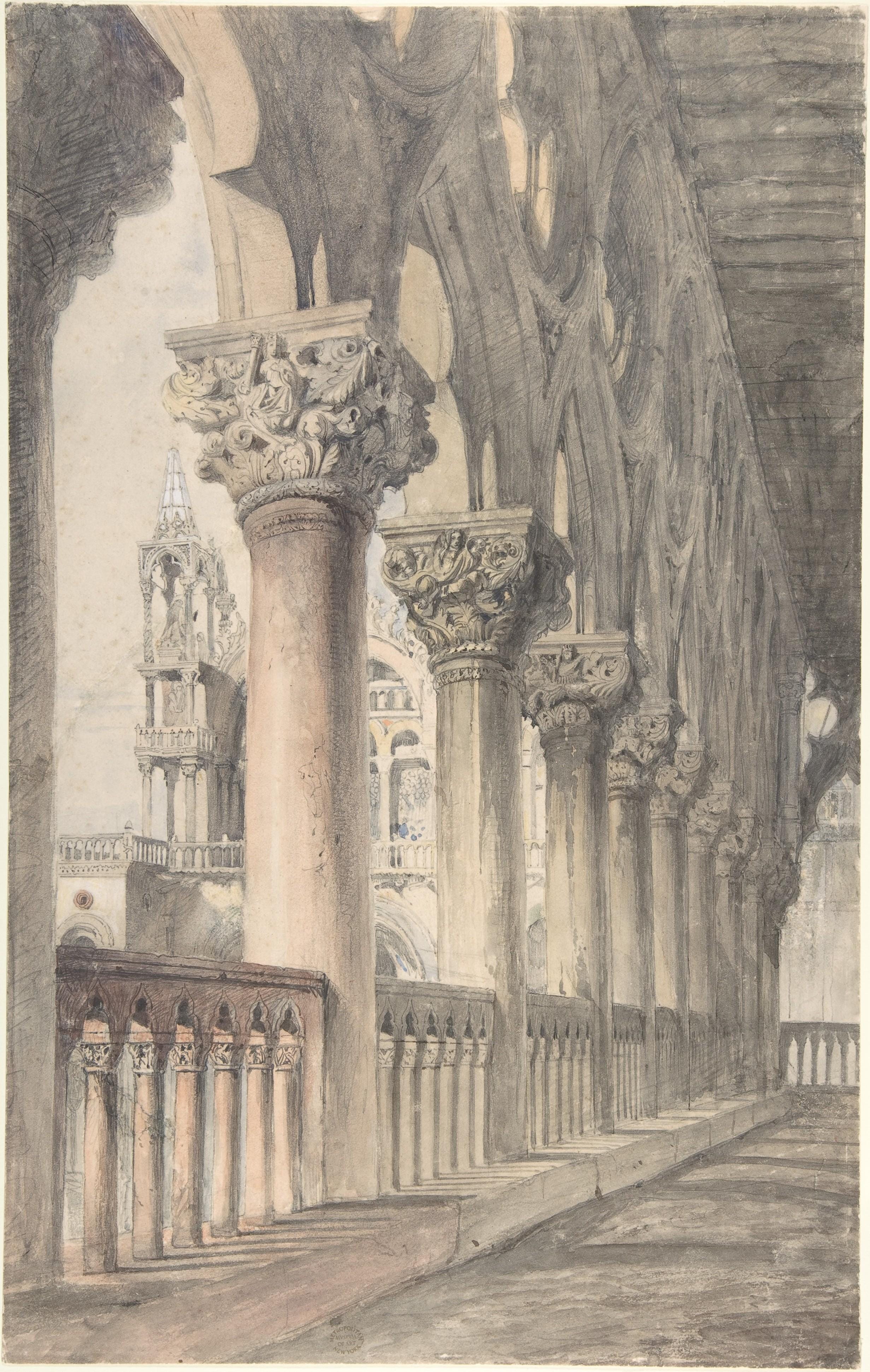
A cathedral is never merely a large pile of decorated rock. It is a society rendered in stone.
The bishop, patron, architect, master mason, sculptor, carpenter, glazier, blacksmith, and laborer occupy different stations. Their work is hierarchical because the building requires unity. Someone must establish the design. Someone must judge whether a wall will stand. Someone must tell the apprentice that his saint resembles an alarmed turnip and ought to be carved again.
Yet hierarchy can govern persons without erasing them.
Ruskin’s quarrel was directed toward forms of labor that separated thought from execution. Industrial production increasingly assigned conception to one class and repetitive motion to another. One person designed the object. Hundreds performed isolated movements without understanding or shaping the whole. The factory gained consistency while the worker lost his relationship to the finished thing.
Ruskin regarded that loss as a moral injury. He argued that the division of labor had divided the human being himself. Industry boasted that it could manufacture pins, cloth, glass, and ornament with unprecedented regularity. Ruskin looked at the workers and asked what the process had manufactured from them.
His answer was severe. A society that purchases flawless objects by denying millions of people the right to think through their work has confused abundance with greatness.
The cathedral workshop followed a different principle. Its craftsmen still divided their labor. A mason did not abandon his stone halfway through the afternoon to try his luck at stained glass. Specialization existed. Yet each craft retained a body of knowledge, an apprenticeship, an internal standard, and some relationship to the completed building.
The worker could point toward the cathedral and say, “I carved that capital.” His children could see it. His neighbors prayed beneath it. His work entered the memory of his city, even when his name did not enter a history book.
Compare that condition with the anonymous manufacture of decorative goods today. A resin mirror is molded in one country, finished in another, sold under a fictitious European brand, and delivered to a customer seeking “Gothic vibes.” Nobody involved possesses a meaningful relationship with the object. Its designer borrowed the silhouette from an architectural tradition he may never have studied. Its workers repeat prescribed motions. Its seller provides a paragraph about “timeless luxury.” The buyer hangs it above a particleboard dresser.
The object resembles Gothic art in the way a plastic fork resembles a silver chalice. The outline survived the journey. Nearly everything else drowned.
Ruskin teaches us to inspect an aesthetic object from behind. Who made it? Under what conditions? From which material? According to which inherited form? For what place? Under whose patronage? What degree of judgment did the maker exercise?
These questions reveal the social order hidden inside the ornament.
A hand-carved wooden frame and a molded resin frame may share pointed arches, trefoils, and black surfaces. Yet the wooden frame bears the grain of a once-living material. Its ornament follows the pressure and direction of the carving tools. Small variations record decisions. The frame grows from an encounter between a design and a substance that occasionally declines to cooperate.
The resin copy offers submission without character. It can be repeated indefinitely because nothing within it resists.
The factory produces objects that obey. The workshop forms people capable of command.
III. How Perfection Became Cheap
Industrial uniformity taught consumers to confuse flawlessness with excellence.
There are forms of craftsmanship that demand severe precision. A clock must keep time. A bridge must bear weight. A cut stone must fit where it belongs. Ruskin was never issuing a universal license for artisans to shrug at measurements and blame their errors on the vitality of the human spirit.
His concern was the worship of finish.
A surface can become so smooth, regular, and controlled that it ceases to reveal the presence of human life. Ruskin found this coldness in architecture that lavished equal effort upon every inch. Nothing received emphasis because nothing had been judged worthy of special attention. The building displayed expensive labor without creative fire.
Modern manufacturing has made such regularity ordinary. A cheap decorative panel can now possess a surface more precise than the handwork of an accomplished medieval craftsman. The panel may still be artistically dead. Exact repetition proves the capacity of the manufacturing process. It says little about the worth of the design.
This has produced a strange reversal. Machine perfection became cheap, so manufacturers began simulating imperfection.
New tables arrive with strategic dents. Metal fixtures receive artificial patina. Factory-made picture frames are rubbed at predetermined points to suggest generations of handling. Vinyl flooring imitates irregular timber. Every plank contains a printed knot, though after living with it for several months one may notice that the same noble knot returns every six feet like an actor playing three peasants in the same opera.
The buyer receives the appearance of history without the burden of inheritance.
Artificial distressing is revealing because it admits what industrial production removed. Consumers still desire evidence of age, touch, variation, and memory. The factory answers by mass-producing those signs. It gives every object the same individuality.
Digital culture performs a similar trick. Filters can add grain, scratches, faded color, paper texture, candlelight, and the soft blur of an old lens. Generated images can assemble medieval tracery, Pre-Raphaelite faces, Gothic interiors, and manuscript borders in seconds. These tools can produce useful studies and arresting pictures. They can also turn the visible signs of tradition into detachable effects.
The danger lies deeper than imitation. When the finished appearance becomes available without the training that once produced it, style separates from human formation.
A person can acquire the image of a woodcut without learning to cut wood. He can decorate a page with manuscript foliage without studying the theological order that governed a medieval page. He can furnish a digital palace before learning to build a tolerable shelf.
The result is an age rich in appearances and poor in makers.
Ruskin would ask whether the image gives evidence of a mind disciplined by sight, material, and inherited form. He would ask whether the artist has learned to observe before learning to perform originality. His drawing instruction began with attention because he believed that most people had never truly seen the natural forms they claimed to admire.
The artist studies the leaf before stylizing it. He studies the old carving before borrowing its grammar. He learns why one line curves and another terminates. He discovers that tradition contains reasons, even where those reasons have been buried beneath several centuries of catalog copy.
Ruskinian irregularity comes after attention. It is born from an imperfect person striving toward a worthy form. Manufactured distress begins with fraud. It designs the evidence of a life that never occurred.
One contains memory. The other comes pre-haunted.
IV. From Purchased Aesthetic to Practiced Craft
A subculture matures when its members learn to make the objects that define its world.
Modern aesthetic subcultures possess strong instincts and weak material foundations.
Goth recognizes the majesty of black, the solemnity of ruins, the attraction of religious ornament, the theatrical power of mourning dress, and the human hunger for beauty touched by death. Dark academia recognizes the dignity of old books, formal study, carved wood, classical languages, and rooms designed for long attention. Cottagecore recognizes seasonal labor, domestic craft, local food, and the charm of household objects whose usefulness does not require an instruction manual.
These instincts can inspire serious work. They can also be trapped inside consumption.
A person assembles the wardrobe, arranges the room, saves thousands of images, and waits for identity to emerge from the collection. The process rarely ends because the market must keep selling new fragments of the promised self. The aesthetic becomes a subscription paid in parcels.
Ruskin offers a sterner path. If you love an object, learn how it came into being.
The admirer of medieval books should study lettering, illumination, binding, paper, parchment, pigments, symbolism, and the ordering of text upon a page. The lover of Gothic interiors should learn joinery, carving, metalwork, textile design, stained glass, or architectural drawing. The devotee of elaborate dress should study pattern cutting, embroidery, natural fibers, historical silhouettes, and the patient mysteries of fitting a garment to an actual human body.
This movement from consumption to creation changes the person.
Materials impose humility. Wood splits. Glass cracks. Gold leaf attaches itself to everything except the intended surface. Thread knots at the moment when the artisan has begun entertaining pride. Every craft contains its own small tribunal.
The beginner discovers that taste is easier than workmanship. Recognizing beauty does not grant the ability to make it. That distance between judgment and capacity can humiliate the aspiring artist, but it can also inspire apprenticeship. The hand slowly learns what the eye demands.
A mature subculture would organize this passage deliberately. Its gatherings would include workshops beside concerts and fashion markets. Its publications would teach historical technique alongside aesthetic commentary. Experienced artisans would receive status because they can transmit an embodied practice. Patrons would commission new work instead of purchasing endless imitations of old work.
Consider a Gothic creative circle studying carved ornament. Its members begin by visiting churches, civic buildings, cemeteries, and museums. They sketch surviving capitals and borders. They identify the plants, beasts, saints, and local emblems contained within them. A practiced carver teaches tool care, grain direction, relief, proportion, and the behavior of several woods.
Each member then carves a small panel according to a common grammar. The panels share dimensions and structural rules. One contains oak leaves. Another contains ravens. A third bears a local flower intertwined with a cross. The pieces belong together without becoming duplicates.
Here is Ruskin’s “changefulness” restored. Unity does not require repetition. The shared form becomes stronger because it can contain many hands.
The circle might install the finished panels in a parish hall, independent school, library, café, or festival chapel. The work enters public life. Its makers become known. New students see the panels and ask to learn. Patrons begin commissioning frames, lecterns, doors, signs, shrines, and furniture.
An aesthetic has begun to acquire a body.
This is how a subculture moves toward high culture. It ceases to depend entirely upon goods manufactured elsewhere. It forms artists, develops standards, gathers patrons, occupies buildings, and hands techniques from one generation to the next.
The wardrobe was an entrance. It was never meant to be the whole cathedral.
V. The Workshop as a Moral Community
Craft survives when correction, loyalty, and shared purpose are housed beneath one roof.
The solitary creator has become one of the sacred figures of modern culture. He works alone, develops an unmistakable personal brand, gathers followers, sells directly, and speaks constantly about his process. His studio is expected to function as workshop, school, gallery, shop, confessional, and broadcasting station.
This arrangement can produce fine work. It seldom produces a tradition.
A tradition requires relationships that outlive a single personality. Masters teach apprentices. Peers judge one another. Patrons support costly undertakings. Communities give the work a destination. Children encounter finished objects and grow up considering their beauty normal.
The workshop joins these relationships under a common discipline.
Its hierarchy should be real. A master earns authority through knowledge, practiced skill, and the ability to correct without indulging vanity. An apprentice enters to learn. He is not praised for arriving. His early work may be awkward, and the workshop serves him best by saying so with precision.
Modern creative culture often mistakes unconditional approval for kindness. Ruskin understood mercy differently. Human work deserves mercy because human beings are imperfect, yet mercy assumes the existence of a standard. Forgiveness has no meaning when every result has already been declared equally admirable.
The worthy workshop holds excellence and patience together.
The apprentice’s crooked leaf may remain upon the wall because it records sincere labor at his present level. He receives correction because he can become better. His dignity rests in being treated as a person capable of growth, rather than a customer whose feelings must be preserved until the payment clears.
Patronage completes the structure. Fine craftsmanship demands time, and time must be supported. A society that praises handmade work while refusing to pay its makers will receive either hurried work or wealthy hobbyists. Neither can bear the full weight of a public culture.
Local commissions provide an answer. A parish needs a processional banner. A school needs a carved sign. A restaurant needs tables. A cultural society needs a lectern. A cemetery needs ironwork. A festival needs gates, costumes, stages, and devotional spaces. Each commission binds the maker’s livelihood to the beauty of a shared place.
The patron also accepts discipline. He must learn the difference between cost and value. He must resist demanding machine speed from human hands. He must permit the maker to exercise trained judgment. A patron who micromanages every chisel mark has hired an expensive pair of arms while keeping all the creative authority for himself.
Ruskin founded the Guild of St George because his criticism eventually demanded a constructive form. He wanted education, craftsmanship, care for land, and honorable labor to exist within an actual association. Books could diagnose the sickness. People joined in common work would have to build the remedy.
Grand Aesthete should take that lesson seriously. Essays about beauty matter when they lead toward schools, salons, workshops, exhibitions, commissions, and buildings. Otherwise, cultural criticism becomes an ornate weather report. The critic announces that ugliness continues, then retires indoors before it stains his cuffs.
A living aesthetic needs a place where somebody is teaching somebody else how to make something difficult.
VI. The Freedom Contained in Obedience
The artist becomes recognizable by submitting himself to something greater than self-expression.
Ruskin’s Gothic craftsman was free, though his freedom bore little resemblance to modern artistic license.
He did not choose his medium each morning according to temperament. He did not invent a private mythology and expect the cathedral to accommodate it. The building already possessed a purpose. Its architecture served Christian worship. Its images belonged to a sacred history. Its dimensions answered structural demands. Its workshop operated beneath masters. Its stone imposed physical limits that no personal manifesto could negotiate away.
Inside those limits, the carver became himself.
This is the paradox modern culture finds difficult to understand. Form can release personality because it gives personality something to shape. Complete freedom often produces vagueness. The artist faced with infinite possibilities begins repeating whatever the market rewarded last Tuesday.
Inherited forms narrow the field. They establish a grammar within which meaningful variation can occur. A poet receives meter. A musician receives mode and harmony. An architect receives site, material, function, and local character. An iconographer receives sacred prototypes, liturgical purpose, and theological boundaries.
Orthodox iconography offers a particularly clear example. The icon painter does not approach Christ, the Theotokos, or the saints as material for private reinterpretation. He receives a tradition of forms that protects the identity and theological meaning of the subject. He learns technique, prepares materials, studies earlier icons, and submits his imagination to ecclesial memory.
Yet one icon is never perfectly interchangeable with another. The hand remains visible. Color, line, rhythm, expression, and compositional emphasis vary among schools and painters. Obedience prevents arbitrary novelty while leaving room for human presence.
The same principle governed the best Gothic carving. The craftsman did not express himself by escaping the cathedral. He expressed himself by serving it faithfully in a manner no other hand could exactly repeat.
This ordered freedom has political meaning.
A healthy hierarchy does not require every subordinate to become identical. It assigns duties, preserves standards, and directs varied gifts toward a common good. Its authority forms persons capable of judgment. A diseased hierarchy hoards thought at the top and demands flawless repetition below.
The first builds a cathedral. The second builds a cubicle farm and hangs motivational typography in the corridor.
Ruskin’s crooked carving reveals a Christian understanding of personhood. Human beings possess worth, yet they remain fallible. Their imperfection calls for correction, patience, and mercy. Their worth demands meaningful responsibility. A social order should recognize both truths.
The modern factory often recognizes neither. It treats the worker as interchangeable while using flattering language about individuality. The market then sells him personalized goods made through standardized processes. He selects a color and is congratulated for self-expression.
Ruskin asks more of us. He asks us to build forms of work in which the person’s hand matters because his judgment matters, and his judgment matters because the common work is worthy of love.
VII. Returning to the Stone Leaf
A civilization worthy of human beings leaves room for their fingerprints.
The weathered leaf remains upon the Venetian capital.
Its maker is probably unknown. Ruskin could not tell us his ambitions, disappointments, family history, or private theory of art. The man did not leave behind an artist statement printed beside a flattering portrait. He left a leaf.
Yet the leaf has survived because it belonged to something greater than its maker. It belonged to a building shaped by a city, a religion, a craft tradition, a system of patronage, and a shared understanding of beauty. Its individuality was preserved by incorporation.
That may be the final lesson of Ruskin’s crooked carving.
Modern culture tells the artist to become unforgettable by detaching himself from everything inherited. He must create a private style, maintain a public personality, and compete for attention against every other living artist and a growing portion of the dead. The result is an immense crowd shouting its uniqueness in remarkably similar ways.
The Gothic craftsman followed another road. He entered a tradition, learned a discipline, accepted rank, served a sacred work, and placed one distinct carving within a structure he would never control. His name vanished. His judgment remained in stone.
We should commission objects whose makers can be named. We should build workshops where hands receive patient training. We should permit materials to retain their character. We should establish standards exact enough to expose fashionable sloppiness and humane enough to recognize living effort. We should give artists worthy buildings, ceremonies, books, garments, and public rooms to serve.
Above all, we should recover the confidence to create unity without demanding sameness.
A machine can produce ten thousand flawless leaves. Each will be smooth. Each will be accurate. Each will be forgettable.
The crooked leaf belongs precisely where one human hand placed it. Centuries later, another person can stand beneath it and feel the presence of a mind working through stone.
That slight irregularity is the opening through which the craftsman returns.
A grand world awaits.


