


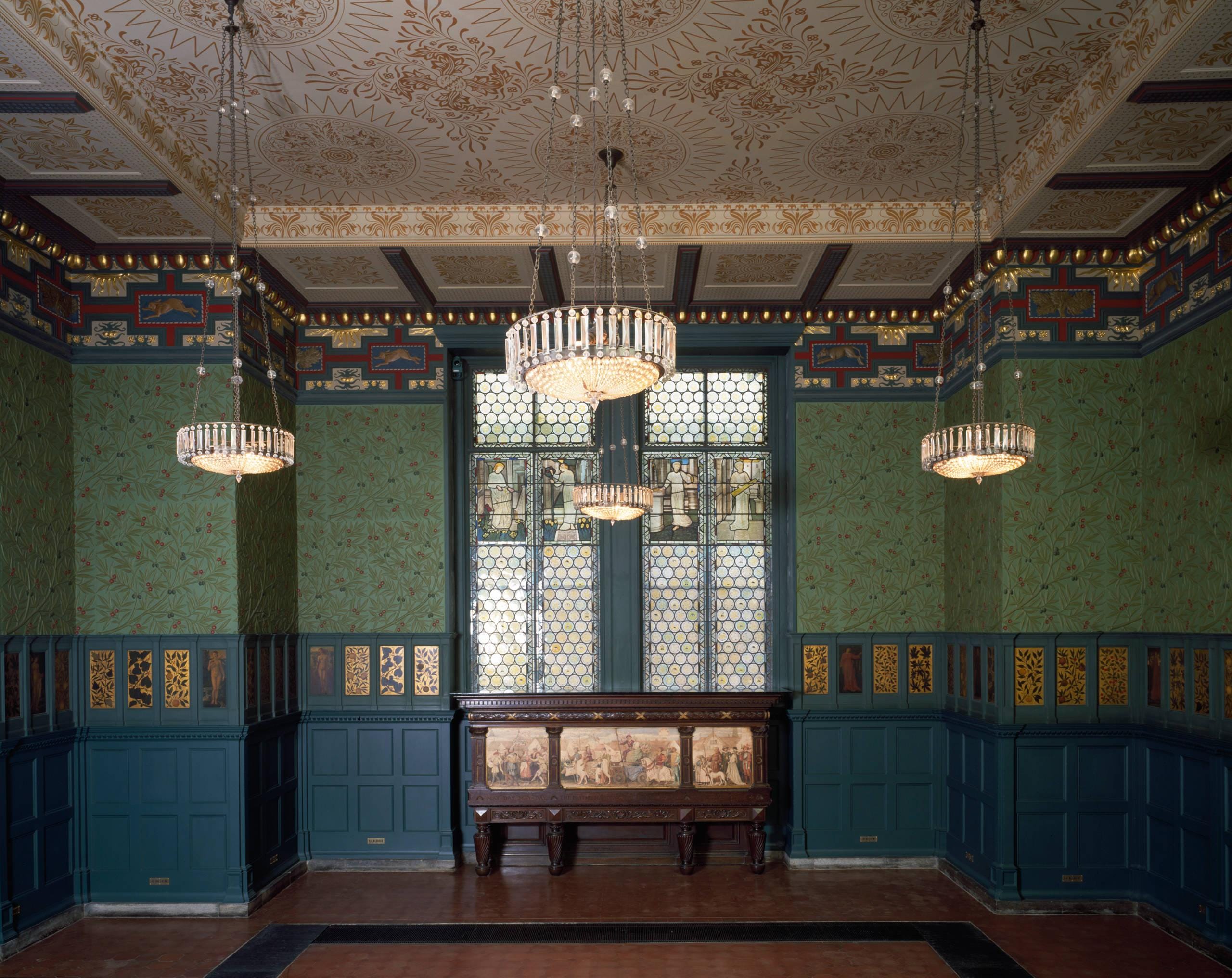
The Green Dining Room at the Victoria and Albert Museum is green in the manner of an old forest after rain. Olive paint covers the paneled walls. Gilded branches climb between dark columns. Edward Burne-Jones’s figures stand within painted panels like inhabitants of a half-remembered romance. Birds, leaves, flowers, and geometric borders occupy nearly every remaining surface.
The room was created in 1866 by the firm of William Morris, with work from Morris, Burne-Jones, Philip Webb, and other members of their circle. It was part of what the museum describes as the world’s first museum café. Even luncheon, Morris seems to say, ought to occur within a comprehensible universe.
No object in the room appears stranded. The furniture, ornament, painted figures, woodwork, and colors speak a common language. Each part possesses its own character, yet each submits to the order of the whole. This is what most modern rooms lack. They contain plenty of objects, sometimes very expensive ones, though the objects seem to have met for the first time that morning.
The Green Dining Room is therefore more than a fine Victorian interior. It is an argument about civilization.
Morris believed that the objects surrounding ordinary life could reveal the condition of labor, the distribution of wealth, the survival of memory, and the ends toward which society directed human attention. A chair disclosed a theory of work. Wallpaper disclosed a theory of nature. The dining room disclosed a theory of fellowship.
A room was a domestic constitution.
I. The Room That Belonged to One World
A beautiful room begins when its objects cease behaving like strangers.
The modern furnished apartment usually arrives as a collection of isolated decisions. The landlord chooses gray flooring because it offends the fewest potential tenants. A furniture company supplies a white cabinet, a synthetic sofa, and a table manufactured from compressed fragments disguised beneath printed wood grain. The inhabitant adds several pictures selected to occupy the correct amount of wall. A screen becomes the visual center because every weak kingdom eventually crowns the loudest object.
The result may be clean. It may photograph well. It possesses no ancestry.
Morris’s Green Dining Room operates by another principle. Its ornament does not sit upon the room as decoration applied after the real work has ended. The ornament belongs to the structure. Painted branches follow architectural divisions. Figures inhabit the panels prepared for them. Color binds wood, plaster, furniture, and image into a single composition. The room feels authored.
The Victoria and Albert Museum’s account of Morris notes that the room contained early examples of the organic patterns that would later define his reputation. That description is correct, though “organic” can sound rather limp after decades of marketing departments attaching it to soap. Morris’s patterns matter because they join natural observation to disciplined order. The leaf is recognized as a leaf, then governed by rhythm, repetition, material, and place.
Preindustrial rooms often acquired coherence without possessing a single designer. Their unity came from a common grammar. Local carpenters knew customary proportions. Masons worked with regional stone. Weavers inherited patterns from earlier weavers. Smiths, embroiderers, painters, and carvers served households shaped by the same calendar, religion, climate, stories, and materials.
Their work contained variations because human hands vary. It remained coherent because those hands belonged to a culture.
Morris discovered remnants of this order in medieval churches, guild workmanship, illuminated manuscripts, vernacular houses, old textiles, and Gothic ornament. He did not approach the Middle Ages as a theatrical warehouse from which attractive motifs could be removed. He encountered evidence of a world in which art remained attached to worship, labor, household, and place.
John Ruskin had prepared the path. In The Stones of Venice, he wrote that Gothic workmanship disclosed “the love and the thoughts of the workman.” The object carried traces of a living intelligence rather than the blank accuracy of mechanical repetition. Ruskin’s discussion of Gothic ornament placed the worker’s moral condition near the center of architectural judgment.
Morris accepted the lesson and built a company around it.
The room that belongs to one world does something modern decoration rarely attempts. It gives visible form to a shared account of life. This was also the argument of “Art Can Rebuild a Shared World”: public beauty gathers memory, aspiration, and social order into perceptible form. The same principle begins at home. Before a people builds a cathedral, it learns what deserves honor at the family table.
II. The Factory Entered the House
Industrial ugliness succeeded because disposability learned to present itself as convenience.
Victorian industrial production could manufacture astonishing quantities of household goods. It could also manufacture astonishing quantities of ugliness.
Factories imitated carved ornament, historical furniture, woven patterns, and aristocratic interiors while severing those forms from the craft traditions that had given them coherence. Decorative details were applied to badly proportioned objects. Gothic arches appeared on cabinets whose construction had nothing Gothic about it. Machines reproduced the outward sign of craftsmanship while removing the craftsman’s judgment from the process.
The failure was deeper than bad taste. Industrial work divided conception from execution.
One man designed a pattern. Another maintained a machine. Another attached components. Another transported the finished article. The merchant presented the result as a complete object, though scarcely anyone involved had made the whole thing or understood it as a whole.
Morris regarded this division as an injury to the worker and the customer. The laborer lost command over his materials, tools, time, and judgment. The buyer received an object whose low price concealed its true conditions of production.
In his 1884 lecture “Art and Labour”, Morris argued that the workman must again become “master of his material, tools, and time.” This mastery did not mean every household object had to be fashioned alone in a woodland cottage by a bearded mystic with excellent sleeves. Morris understood that machines could spare people from degrading labor. He objected when the machine ruled the worker and cheapened the work for profit.
Our factories are cleaner than many Victorian mills. The domestic economy Morris opposed has grown stranger.
A modern table may be designed on one continent, manufactured on another, sold through a platform headquartered on a third, and delivered by a man judged by an invisible timer. Its surface imitates timber. Its joints resist repair. Its price seems remarkably low because the ecological, social, and human costs have been scattered until no single receipt contains them.
When the veneer peels, the table is discarded. Repair would cost more than replacement because the object was never meant to possess a history.
Compare it with a solid oak table made by a local cabinetmaker. The initial price is higher. The cost has nowhere to hide. Someone selected the boards, studied their grain, cut the joints, leveled the surface, and applied a finish that can be renewed. The table will be marked by meals, arguments, homework, feast days, spilled wine, and the occasional uncle whose theory of coasters remains distressingly abstract.
Those marks become part of the object.
The factory table participates in a sales cycle. The crafted table participates in a family.
This distinction explains why the commercial defense of cheap goods remains incomplete. Low prices can grant households access to necessary comforts. They can also destroy the workshops capable of producing better things. Once the trained cabinetmaker disappears, the consumer has gained inexpensive furniture and lost the practical possibility of commissioning an heirloom.
As “Artists Are Right to Hate the Free Market” argued, markets record demand under given conditions. They cannot determine whether the chair deserves inheritance or the building deserves affection. That question belongs to judgment.
III. The Politics Concealed in Wallpaper
Whoever furnishes the home quietly decides what ordinary people are permitted to consider beautiful.
Consider Morris’s Willow Bough. Slender branches cross the surface in measured curves. Leaves bend around one another. Repetition creates order, yet the pattern never becomes inert. It seems to continue beyond the limits of the paper, as though the wall had opened upon a cultivated thicket.
Morris designed it after studying willow trees near the Thames. Nature provided the vocabulary. Craft supplied the syntax.
The distinction matters. A photograph of leaves pasted across a wall would reproduce natural appearance without interpreting it. A purely geometric design could impose order without preserving the particular character of the willow. Morris joined observation and form. He permitted the plant to remain itself while teaching it to inhabit architecture.
The V&A collection of Morris designs preserves celebrated patterns such as Willow Bough and Strawberry Thief across textiles, tiles, wallpapers, stained glass, and furniture. Their continued popularity presents an irony Morris would have appreciated with clenched teeth. Patterns created in rebellion against industrial ugliness are now endlessly reproduced on mass-market mugs, phone cases, tote bags, and objects whose chief relationship to craftsmanship is that they survived a conveyor belt.
Yet the original achievement remains. Morris taught that pattern could discipline attention. A person living among such forms sees branches, intervals, colors, repetitions, and variations each day. The wall becomes a quiet education in order.
This made wallpaper political.
Taste is often treated as private preference, a decorative mist floating above serious matters. Morris refused that separation. If common people labored amid ugliness, returned to ugly streets, and furnished their homes with cheap imitations, their deprivation could not be measured by wages alone. They had been denied daily contact with beauty and denied pleasure in creating it.
His objection placed him in an awkward position. Morris & Co. produced costly goods for wealthy patrons. Its workers used demanding materials and time-consuming methods. The company that sought to restore beauty to ordinary life often sold that beauty to prosperous households.
The contradiction is real. It is also instructive.
Handcrafted goods cannot be cheap when craftsmen receive honest pay, materials remain worthy, and the work requires years of acquired skill. One can lower the price by simplifying the design, coordinating production, or accepting smaller margins. Past that point, cheapness must be extracted from someone or something. The worker, the material, the environment, the longevity of the object, or all four will settle the account.
Morris therefore confronted a problem that remains with us. How can common households possess beautiful things without impoverishing those who make them?
His social answer sought a sweeping reordering of labor and property. A more immediate answer begins with selective permanence. A household can own fewer objects of greater consequence. It can commission one good table rather than replace four poor ones. It can restore inherited furniture, purchase used craftsmanship, learn basic repairs, and allow a room to develop across decades.
The beautiful home need not arrive in a truck on Saturday morning. That urgency belongs to the merchant. A household has generations.
IV. The Room Forms the Person
We become attentive or careless partly through the things we touch every day.
A handmade ceramic cup asks to be held differently.
Its lip may vary slightly in thickness. The glaze gathers more deeply in one place. A faint mark records where the potter’s hand directed the clay. Because the cup is particular, breaking it would mean losing this cup rather than one replaceable unit from a set.
Care begins in such small recognitions.
Disposable objects encourage disposable conduct. We handle them roughly because nothing of consequence appears to be at stake. Repairable objects invite maintenance. Inherited objects impose an obligation. Sacred objects demand reverence. The material world teaches the body how to behave long before anyone turns the lesson into a theory.
Rooms conduct the same education at a larger scale. A table placed at the center of domestic life gathers a household around meals, work, conversation, and hospitality. Chairs aimed toward a television establish spectatorship as the common rite. A library grants reading architectural dignity. A front porch permits casual contact with neighbors. A prayer corner directs the household toward God.
Furniture has politics because furniture arranges bodies.
The point becomes especially clear within an Orthodox Christian home. An icon corner does more than display religious art. Its orientation, lamp, incense, prayer books, and images establish a sacred center. The household turns toward it in morning prayer. Feast-day customs alter the table. Icons connect the domestic room with the liturgical life of the Church.
Such an interior contains different degrees of honor. The icon is not interchangeable with a framed poster. The dining table is not a convenient ledge for unopened packages. The room becomes comprehensible because its objects occupy places fitted to their purposes.
This is hierarchy in its most humane form. Higher and lower do not imply contempt. They permit every object and action to receive an appropriate place.
Morris did not share Orthodox theology, yet his domestic art often points toward sacramental perception. Material things possess meaning through their relationship to human purpose, communal memory, and the natural order. Pattern makes growth visible. Craft gives labor visible dignity. The room gathers these forms into daily ritual.
As “Magic Is the Art of Making the Sacred Perceptible” argued, art becomes culturally serious when it makes objects for actual rites, households, feasts, funerals, chapels, and communities. A carved door made for a particular church carries a significance no decorative door ordered from a catalog can manufacture. One has entered a covenant of use. The other has entered a cart.
Beauty forms the person because repeated encounters become habits of perception. The child who grows up among natural wood, embroidered cloth, good books, icons, gardens, tools, and repaired objects receives an education in patience before learning the word. He sees that material things come from somewhere, require care, and may outlast their present owners.
A home filled with disposable objects teaches another lesson. Nothing lasts. Nothing asks loyalty. Replacement is easier than repair.
Eventually this lesson escapes the furniture.
V. From Private Taste to a Creative Order
The beautiful room survives when a community can make its parts.
A contemporary craft fair often presents a sad arrangement beneath its cheerful tents. A potter, cabinetmaker, weaver, printer, metalworker, and iconographer sit within a few yards of one another. Each possesses fragments of the skill required to furnish a beautiful common life. Each struggles to find regular patrons. Visitors praise the work, photograph it, and purchase something inexpensive enough to require no decision.
Admiration alone will not preserve a craft.
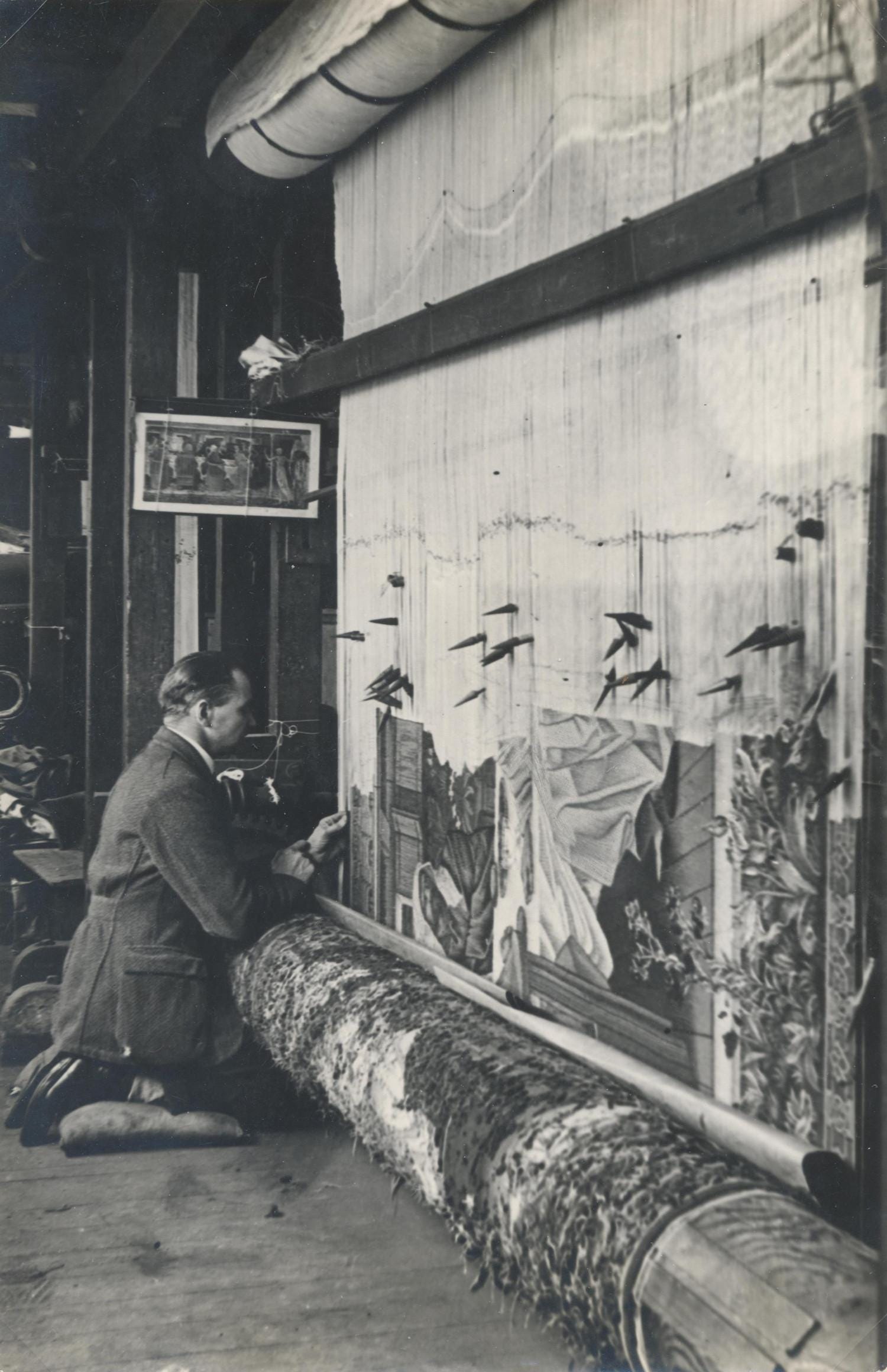
Morris understood this because he worked through a circle. Morris, Marshall, Faulkner & Co., founded in 1861, brought together painters, architects, designers, embroiderers, stained-glass makers, and craftsmen. Their collaboration moved across furniture, textiles, wallpaper, books, tiles, metalwork, and entire interiors. The work possessed coherence because the makers shared sources, standards, friendships, and arguments.
They built a school before later generations reduced their school to a style.
The distinction is decisive. A style can be purchased. A school must be entered. It requires study, correction, apprenticeship, technical mastery, patronage, and transmission. A style produces recognizable products. A school produces people capable of judgment.
This is why the solitary online maker remains vulnerable. A storefront may provide access to customers, though it cannot supply a complete cultural order. The craftsman still needs suppliers, pupils, critics, collaborators, commissions, and neighbors who understand why his work costs more than its factory imitation.
The answer is a local household-arts guild.
Such a guild need not begin with medieval robes, ceremonial titles, or a secretary carrying a silver hammer, pleasant though these temptations may be. It could begin with twelve serious people: several makers, several patrons, a church representative, an architect, a historian, and one person capable of organizing dinner without founding a committee about the napkins.
The guild could maintain a directory of trusted craftsmen. It could arrange studio visits, apprenticeships, lectures, exhibitions, and group commissions. Several households might commission related dining tables, reducing repeated design costs while preserving handwork. A parish might employ local woodcarvers, embroiderers, metalworkers, iconographers, and printers when repairing or furnishing its church. A regional pattern book could draw upon native plants, local history, Christian symbols, and older building forms.
Standards would matter. Handmade work is not automatically good. A badly proportioned chair does not acquire greatness because its maker owns a charming apron. The guild must judge construction, fitness, material, beauty, and durability. Praise without discrimination turns craft into a charity for tasteful shoppers.
Patrons need education as much as makers. They must learn how long good work takes, what materials cost, which compromises preserve the design, and which ruin it. They must also recover patience. A commissioned object may require months. This is a feature of entering a human relationship rather than pressing a button and tracking a rectangle across three states.
Morris’s “Useful Work versus Useless Toil” distinguished work that gives pleasure and produces worthy goods from labor consumed by waste and artificial demand. His language was socialist, though the insight reaches beyond party doctrine. A healthy social order gives the worker some authorship over his labor and gives the community goods worthy of the life spent making them.
The guild joins those concerns. It grants the craftsman a public role and gives the patron a duty beyond shopping.
VI. The Beautiful Room as a Public Argument
A household furnished with care testifies that human life deserves permanence.
Return to the Green Dining Room.
The painted figures remain in their panels. Gilded branches still rise across the walls. Dark wood divides the surfaces. Pattern, architecture, furniture, and image continue speaking after the commercial setting that produced them has passed into history.
The room endures because many arts were persuaded to speak together.
Its survival also exposes the weakness of treating beauty as private self-expression. Morris did not fill the room with unrelated objects that disclosed his personality. He submitted his personality to a common work. Burne-Jones did the same. Webb did the same. Each contributed a recognizable hand, yet the room mattered more than any single gesture.
This is how culture is built. The artist receives forms he did not invent, adds something worthy, and hands them forward.
The beautiful room therefore contains a quiet politics. Repair weakens dependence upon perpetual replacement. Local craftsmanship preserves knowledge that cannot be stored fully in manuals. Inherited objects join generations. Hospitality turns private property toward common life. Sacred order places the household beneath an authority higher than appetite and fashion.
None of this requires turning the home into an aesthetic bunker.
Morris’s error, when his romanticism tempted him toward it, was the hope that a sufficiently beautiful retreat might stand apart from the industrial city. His greater work points outward. The ordered room calls for the ordered workshop. The workshop calls for patronage. Patronage calls for shared standards. Shared standards seek expression in churches, schools, libraries, inns, gardens, streets, and halls.
The room is a beginning.
A household can start with the objects that govern daily life. The table. The bed. The chair. The lamp. The cabinet. The icon shelf. Study how each is made. Restore what can be restored. Replace slowly. Commission when possible. Learn one craft well enough to recognize the cost of mastery. Invite craftsmen into the home as honored makers rather than anonymous vendors.
Then open the door.
Gather artists and patrons around the table. Discuss the church that needs new furnishings, the shopfront that deserves a painted sign, the festival that needs banners, the neglected hall that could host an exhibition, the young apprentice searching for a master. Let the beautiful room become the meeting place from which public beauty returns.
Morris’s deepest lesson was never that everyone should cover the walls with Strawberry Thief. His lesson was sterner. Beauty cannot be separated from the manner in which people work, worship, inherit, dwell, and exchange gifts. A civilization that wishes to recover beautiful rooms must recover the human relationships capable of making them.
Look once more at the Green Dining Room and consider the hands concealed within its surfaces: the painter’s brush, the joiner’s plane, the gilder’s tool, the designer’s pencil. The room still lives because those hands worked within a common vision.
Our rooms wait for one.
A grand world awaits.


