

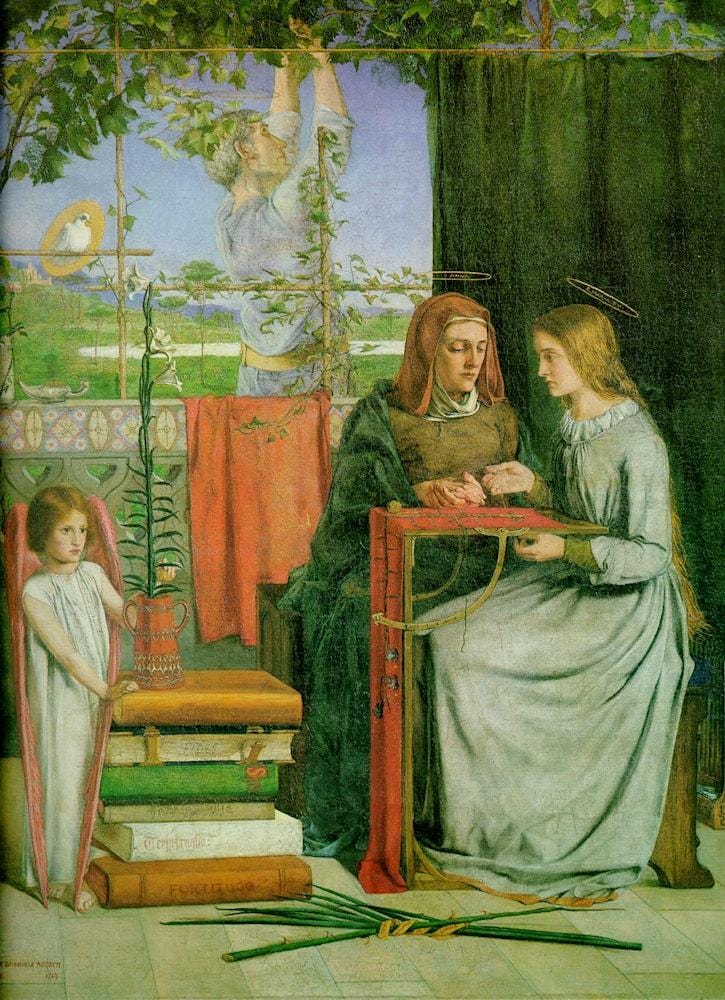
In 1849, visitors to the Free Exhibition in London encountered an unusual painting of the Virgin Mary as a girl. She sits beside her mother in a narrow room, embroidering a red cloth beneath the supervision of an angel. A lily stands on a pile of books. A palm branch crosses the wall. Outside, her father tends a vine. Every object carries meaning, yet each remains stubbornly physical: thread, timber, leaves, cloth, hands.
The painter was Dante Gabriel Rossetti. His mother and sister had served as models. Beneath the canvas appeared three unexplained letters: P.R.B.
The initials belonged to the newly formed Pre-Raphaelite Brotherhood, seven young men united by dissatisfaction with British painting. They believed the Royal Academy had reduced art to theatrical poses, muddy color, and inherited formulas. Their answer was neither solitary protest nor historical cosplay. They formed a circle. They named their principles. They trained their eyes, published their arguments, defended one another, sought patrons, and produced work recognizable as the expression of a common vision.
Their methods offer an unusually complete model for modern aesthetic subcultures. Goth, dark academia, fantasy art, medieval revivalism, and other online scenes already possess recognizable imagery and large audiences. What they generally lack is organized transmission. They have consumers without apprentices, influencers without critics, merchandise without workshops, and followers without membership.
The Pre-Raphaelites show how an aesthetic can escape that condition. Their Brotherhood was brief, disorderly, and often personally disastrous. Yet the world it disclosed spread from painting into poetry, textiles, furniture, stained glass, architecture, book design, and domestic ritual. It became larger than the men who first placed three mysterious letters beneath their paintings.
I. Seven Men and Three Mysterious Letters
A movement begins when private dissatisfaction acquires a name, a discipline, and witnesses.
The Pre-Raphaelite Brotherhood took shape in September 1848 at the Millais family home in London. Its central founders were John Everett Millais, William Holman Hunt, and Dante Gabriel Rossetti. William Michael Rossetti, James Collinson, Frederic George Stephens, and Thomas Woolner soon joined them, bringing the number to seven.
The first Pre-Raphaelite paintings did not arise from a market survey. They came from arguments among ambitious young artists who believed the reigning school had forgotten how to see. Millais possessed astonishing technical gifts. Hunt supplied moral severity and persistence. Rossetti brought poetry, medieval romance, religious imagery, and a splendid capacity for making every friendship slightly more complicated than necessary.
Their secret initials did useful cultural work. P.R.B. created curiosity among critics, but secrecy was secondary. The letters marked allegiance. Each member retained his own subjects and manner, yet placed his reputation behind a common judgment. Anyone could imitate the surface. Only members carried the signature.
That distinction separates a movement from a demographic. An aesthetic audience may share preferences, clothes, playlists, and photographs. A brotherhood shares obligations. Its members can demand better work from one another. They can assign study, organize exhibitions, record decisions, make introductions, identify failures, and defend their school before the public. The seven original members and their brief revolt mattered because they converted taste into association.
Older European culture commonly produced art through such bodies. Monasteries maintained scriptoria. Workshops trained painters and sculptors. Guilds guarded standards. Courts gathered poets, musicians, architects, theologians, and patrons around a ruling house. The Romantic cult of the solitary genius obscured this social foundation, though even the Romantics travelled in circles and quarreled in packs.
Modern aesthetic communities possess larger audiences than Rossetti could have conceived. A medieval interior may receive a million views before luncheon. Yet the viewers often know no carpenter who could build its table, no weaver who could reproduce its hangings, and no iconographer who could explain why the figures face the viewer as they do. The audience has acquired recognition without possession. It can identify the atmosphere while remaining helpless before the materials.
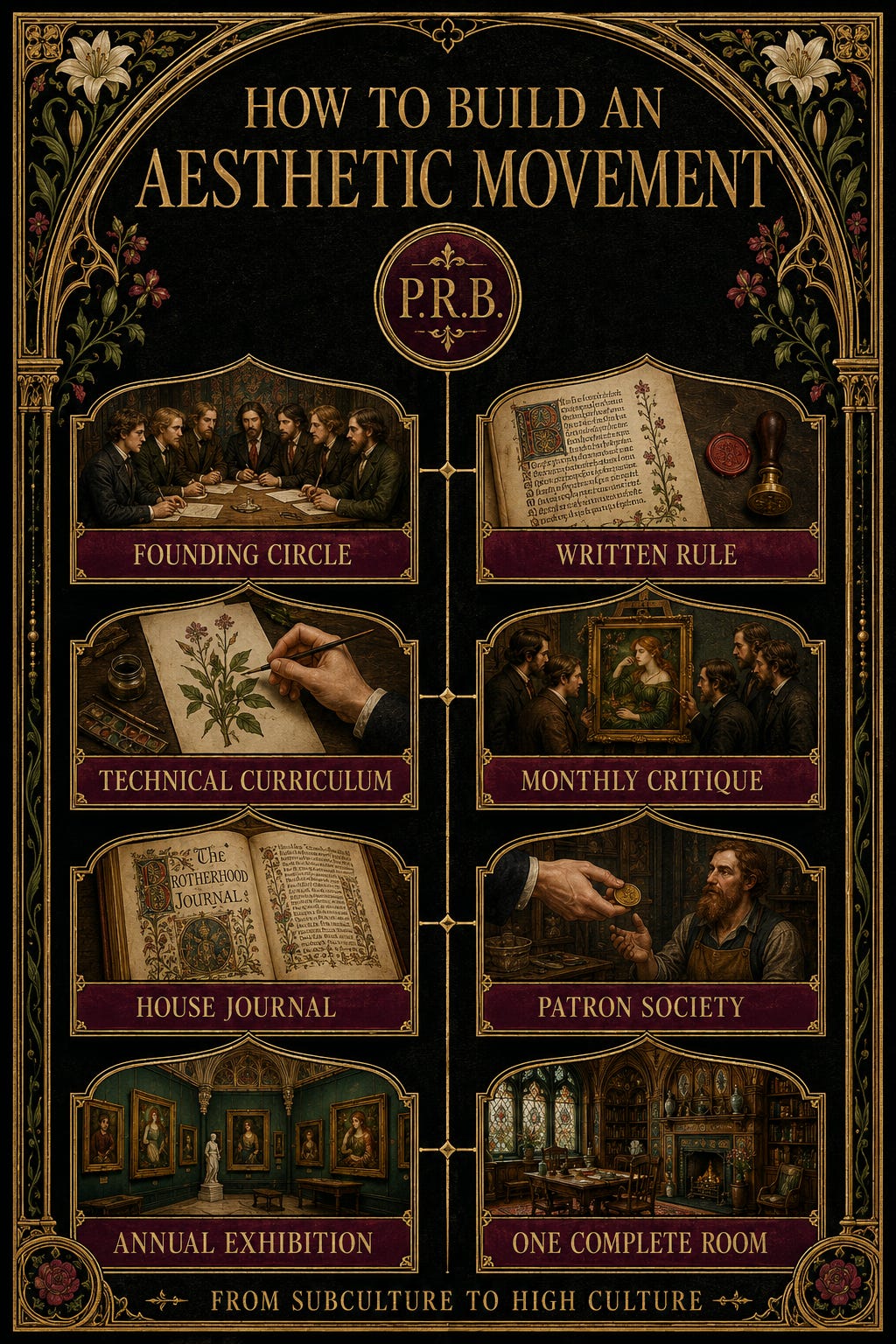
A serious contemporary circle should begin small. Five to eight artists, writers, craftsmen, and organizers are enough. It needs a name, a statement of purpose, an admission standard, a common reading program, monthly criticism, and one annual work bearing a collective mark. A shared tradition of apprenticeship gives imitation a human setting in which correction can occur.
The purpose is fellowship organized around work. Friendship may inspire the first meeting. Work must justify the second.
II. A Revolt Against Dead Painting
The Brotherhood rebelled successfully because it could name what the academy had lost.
The young Pre-Raphaelites reserved particular contempt for Sir Joshua Reynolds, the first president of the Royal Academy. They called him “Sir Sloshua,” a joke aimed at the loose handling, brown varnish, generalized forms, and grand theatrical manner they associated with academic painting. Young men have always enjoyed renaming their elders. Occasionally they also possess a case.
Their phrase “before Raphael” requires care. They did not regard Raphael as an artistic incompetent, nor did they propose returning Europe to a blissful age when painters had not yet solved perspective. They opposed the formulas attributed to Raphael’s successors. In the late medieval and early Renaissance masters, they found lucid color, exact detail, direct composition, religious seriousness, and an attention to the created world that later academic convention had softened into manner.
Millais made the charge visible in Christ in the House of His Parents. The Holy Family appears inside a working carpenter’s shop. Wood shavings cover the floor. Joseph’s hands bear the marks of labor. The young Christ has cut his palm on a nail. Blood falls onto his foot. Sheep crowd outside the door while tools, timber, and unfinished work surround the figures.
Charles Dickens hated it. Mary looked too ordinary. Joseph seemed rough. The workshop appeared dirty. The painting offended viewers because it restored physical weight to the Incarnation. Holiness had entered a real shop, where boards warped, hands cracked, and nobody had instructed the sawdust to arrange itself decorously. The controversy forms a central episode in the chronology of English poetry and Pre-Raphaelitism, since the Brotherhood’s visual revolt was inseparable from its literary and religious sources.
Their rebellion carried force because it issued a precise indictment. “Modern art is ugly” would have produced another youthful complaint. The Brotherhood named the faults: brown tonal habits, stock gestures, borrowed compositions, sentimental sacred figures, indifference to natural detail, and technique severed from conviction. Each accusation implied a course of study.
That principle matters for every aesthetic subculture. Goth cannot mature through declaring modern architecture soulless. It must recover masonry, tracery, proportion, ironwork, stained glass, sacred geometry, woodcarving, and the theology that gave those forms their hierarchy. Dark academia cannot answer fluorescent schools by purchasing another tartan skirt. It must recover disciplined reading, ordered conversation, learned friendship, beautiful libraries, intellectual inheritance, and the duties owed to knowledge.
The Brotherhood also grasped that nature was legible. Created things possessed forms that deserved attention, and those forms could bear symbolic meaning. A lily could signify purity without ceasing to be a particular plant. Timber could recall the Cross while remaining the carpenter’s material. The Pre-Raphaelite return to medieval vision therefore joined observation to symbolism.
A modern circle should write its own indictment, though it should keep the document shorter than its appetite for indignation. It should name five visible failures in contemporary work and pair each with an older standard. Bad synthetic fabric leads to textile study. Empty symbolism leads to theology and iconography. Weak drawing leads to anatomy. Historical pastiche leads to research in original garments, buildings, and tools.
Complaint becomes culturally useful when it produces a curriculum. The Pre-Raphaelite reading tradition remains instructive because these artists read poetry, criticism, legend, scripture, and history around their practice. They did not expect paint to rescue them from ignorance.
III. Truth to Nature Required Labor
The Brotherhood’s sincerity appeared in its methods before it appeared in its subjects.
Millais began the background of Ophelia beside the Hogsmill River in Surrey. He painted outdoors for months, fighting insects, weather, and the unreasonable habits of English vegetation. The water plants, willow branches, flowers, and riverbank were observed with such precision that botanists can identify them. Nature appears luxuriant, though nothing has been tossed into the scene merely to make it look lush.
The flowers carry inherited meanings. Poppies suggest death. Daisies signify innocence. Violets evoke faithfulness and early death. Forget-me-nots add a meaning absent from Gertrude’s speech in Hamlet. The painting’s language of flowers joins Shakespearean tragedy, botanical knowledge, Christian symbolism, and the exact life of an English riverbank.
Elizabeth Siddal later posed as Ophelia in a bathtub warmed by lamps. At one point, the lamps went out. Millais continued painting while the water cooled, and Siddal became ill. The episode has become part of the painting’s legend, though its moral is less romantic than admirers sometimes pretend. A beautiful result does not excuse careless treatment of the person whose freezing body made it possible. Artists possess a remarkable talent for calling preventable misery “the process.”
The work itself remains a rebuke to contemporary aesthetic production. An image generator can produce a pale red-haired woman floating among flowers within seconds. A photographer can assemble the familiar signs of Pre-Raphaelitism: copper hair, embroidered dress, sorrowful gaze, abundant foliage, jeweled light. Yet surface recognition supplies no knowledge of botany, Shakespeare, pigment, anatomy, sacred symbolism, fabric, or death.
Millais’s achievement arose from the unity of these fields. The painting’s literary and artistic ancestry gave its natural detail direction. Observation prevented symbolism from becoming a code pasted onto dead scenery. The material world and the inherited story interpret one another.
A modern goth painter should adopt the same severity. Study funerary sculpture closely enough to distinguish mourning conventions by century. Draw drapery until folds respond to weight rather than vague melancholy. Learn how candlelight changes flesh, metal, stone, and velvet. Read the prayers once spoken before the tombs being borrowed as scenery. Visit a church when nobody is taking photographs.
Technical habits create the depth later recognized as style. The Pre-Raphaelites worked over bright grounds, used brilliant pigments, studied outdoors, copied natural forms, researched dress, and drew insistently. Their school became recognizable because its members submitted themselves to common demands. A filter can produce resemblance. Discipline produces family likeness.
The present artist needs a technical rule of life: weekly drawing, monthly material study, architectural sketching, copying from a chosen master, symbolic reading, and seasonal work outdoors. The strange history of Siddal’s pose, explored through poetry about the making of Ophelia, also suggests a further rule. Models, assistants, seamstresses, and craftsmen must be treated as participants whose bodies and labor impose duties on the artist.
Truth to nature was never passive looking. It was trained attention joined to moral responsibility.
IV. The Brotherhood Published Its Own Argument
A school must explain itself before hostile critics explain it badly.
In 1850, the Brotherhood published The Germ: Thoughts towards Nature in Poetry, Literature and Art. It lasted four issues.
Commercially, this was less a triumph than a dignified collision with the furniture. Culturally, it mattered. The journal gave the Brotherhood a language beyond painted surfaces. It carried poetry, fiction, criticism, and statements concerning art. The members could identify their ancestors, describe their principles, and place visual work inside a larger intellectual cause.
William Michael Rossetti served as editor and recorder. His role reveals a truth often missed by aesthetic circles: the person who keeps minutes, edits manuscripts, preserves correspondence, and remembers what was decided may shape a movement as deeply as the most visible artist. Without such labor, memory becomes a mist inhabited chiefly by the founder’s favorite version of events.
The Brotherhood also benefited from John Ruskin’s public defense. After fierce attacks on their work, Ruskin wrote to The Times in their support. He did not approve everything they made, and his later personal involvement with the circle became famously tangled. Still, he recognized their close study of nature and placed it within a moral account of craftsmanship. The surviving body of Pre-Raphaelite art and criticism shows how painting, poetry, and interpretation reinforced one another.
Aesthetic movements require more than artists. They need editors who can distinguish argument from fog. They need historians who can trace sources, photographers who can document work, clergy who can examine sacred claims, critics who can judge failures, and organizers who can persuade everyone to arrive in the same room before the exhibition closes.
Online subcultures have reversed this order. Commentary appears in abundance while durable work remains scarce. People explain an aesthetic they have never practiced, then explain one another’s explanations until the original object disappears beneath a small mountain of captions. A proper journal should return attention to made things.
Such a publication might contain a new painting, a serious poem, a translation, workshop notes from a bookbinder, criticism of an exhibition, a study of church ornament, and photographs of a completed commission. Each issue should recover one source, name one exemplary contemporary work, correct one fashionable error, and record something the circle has built.
The journal also establishes continuity. The Pre-Raphaelite archive of texts and scholarship allows later readers to reconstruct the school’s arguments rather than guessing from red hair and lilies. A movement that leaves no records eventually becomes whatever its least careful admirer says it was.
This is why a house publication should contain statements of standards as well as praise. Taste matures through distinction. Editors must be willing to say that one work understands medieval composition while another has placed a woman in a velvet dress beside an arch and hoped history would handle the remainder.
Publication can also attract defenders and patrons. Artists working separately appear as curiosities. Artists who publish together reveal a body of thought. As accounts of working artists outside the studio make plain, careers depend upon collectors, curators, exhibitions, commissions, and the slow accumulation of trust. A journal makes that supporting structure visible.
Every serious movement requires someone to build its memory before nostalgia arrives and falsifies it.
V. Patronage Turned Rebellion into a Career
No school survives for long on indignation and borrowed paint.
The Pre-Raphaelites needed buyers. Paint, models, studios, travel, frames, printing, and time all cost money. The spiritual seriousness of art has never caused the landlord to waive the rent. One may regret this without pretending surprise.
Thomas Combe, superintendent of the Oxford University Press, became an early patron of Millais and Holman Hunt. John Ruskin provided financial, intellectual, and social support. Later collectors such as Frederick Richards Leyland purchased major works by Rossetti and Burne-Jones. These relationships gave artists commissions, introductions, security, and access to rooms where reputations were made.
Patronage does more than purchase finished pictures. A capable patron can finance preparatory drawings, commission an unfashionable sacred subject, send an artist to study architecture abroad, connect a painter with a craftsman, or support an apprentice during the years when skill grows faster than income. The old system joined money to authority, taste, and obligation. A useful account of patronage as permission shows that contracts, religious authorities, collectors, and public standing all shape what artists can make.
Modern culture prefers the flattering fiction that artists achieve success through exposure. Exposure is frequently the art world’s tender name for unpaid labor. Serious production requires payment, and payment should carry clear terms.
A contemporary patron circle could begin modestly. Ten households might each contribute to one substantial annual commission: a carved processional cross, a cycle of paintings, an illuminated book, stained-glass panels, vestments, a memorial sculpture, or the furnishing of a reading room. The artist would submit drawings. The patrons would provide written requirements, pay for stages of work, and document the process.
This arrangement restores responsibility to both parties. Artists must deliver craftsmanship rather than attitude. Patrons must study enough to commission intelligently. Money without taste produces expensive clutter, while taste without money produces a superbly curated folder of saved images.
Pre-Raphaelite success also revealed the danger of popularity. Its imagery became decorative, fashionable, and reproducible. The market learned to sell the maiden, the flowers, the medieval dress, and the luxuriant surface while discarding the discipline beneath them. Contemporary luxury goth faces the same temptation. Silver, velvet, hand-carved furniture, and stained glass may support fine work. A high price proves only that the seller has met someone willing to pay it. The costly plastic bat remains a plastic bat, though it now carries itself like minor nobility.
The proper model is stewardship. The best contemporary relationships between brands, collectors, and artists treat commissions as continuing artistic relationships, with attention to place, materials, and repeated work. This gives artists enough stability to attempt difficult pieces while giving patrons a share in creating a public inheritance.
Such support should extend beyond celebrated painters. Printers, framers, weavers, carvers, photographers, restorers, and editors keep an artistic school alive. The history of women who shaped art through patronage also shows that cultural authority belongs partly to those who recognize talent early, pay its bills, and bring new buyers into the circle.
Patronage turns admiration into responsibility. The patron says, in effect, that this work deserves to exist and accepts part of the cost of bringing it into being.
VI. From Paintings to a Complete World
The Pre-Raphaelite vision became powerful when it escaped the frame.
A painting can reveal a world. A room forces someone to live within it.
The second generation carried Pre-Raphaelite principles into furniture, stained glass, embroidery, wallpaper, books, architecture, and household objects. Edward Burne-Jones expanded its dreamlike religious and legendary imagery. William Morris gave the movement workshops, products, and interiors. Together with Philip Webb, Rossetti, Ford Madox Brown, and others, Morris formed Morris, Marshall, Faulkner & Co. in 1861.
The firm made stained glass, furniture, textiles, painted decoration, metalwork, and wallpaper. Its purpose was greater than attaching medieval ornaments to industrial objects. Morris wanted the making and the made object to recover a human relationship. The range of Morris and Company’s work joined design, material, narrative, and labor across the household.
Red House supplied the architectural proof. Designed by Philip Webb for Morris and his wife Jane, it brought built-in furniture, painted tiles, textiles, stained glass, garden, and structure into one coherent dwelling. Friends helped furnish it. The house was a social act made habitable. Its gabled brick walls and handmade interior show what happens when a circle stops arranging objects for photographs and begins creating an environment.
This is the decisive passage from subculture toward high culture. A subculture usually starts with portable signs because its members control little property. Clothing, jewelry, records, makeup, posters, and bedroom decoration allow them to carry a small world through surroundings designed by someone else. That beginning is understandable. Remaining there forever is a confession of impotence.
Goth matures when it can furnish a chapel, library, memorial hall, garden, theater, or house. Dark academia matures when it founds a serious school, maintains an archive, publishes learned books, and creates rooms in which study becomes a common discipline. Fantasy art matures when it supplies sculpture, metalwork, music, ritual, and architecture rather than endless portraits of warriors who appear never to have met a blacksmith.
A local circle should choose one complete environment each year. A church reading room would suffice. One member designs the shelves. Another carves ornament. Another binds books. A textile artist produces curtains or cushions. A painter creates a sacred or historical panel. A patron pays for materials. The group publishes the plans, costs, mistakes, and finished result.
This method converts admiration into mastery. It also reveals whether the aesthetic possesses internal order. Colors must relate. Symbols must agree. Materials must suit their purpose. Furniture must support the body rather than merely impress a camera. A total room permits fewer evasions than a mood board.
The Arts and Crafts defense of handmade objects carried Pre-Raphaelite principles into daily use. That achievement should be recovered without romanticizing every economic theory attached to it. The central lesson remains sound: beauty must enter ordinary life through trained hands.
An aesthetic becomes a culture when it can build the room in which its people eat, pray, read, mourn, and welcome strangers.
VII. The Women Inside the Frame
A mature school must distinguish genuine participation from beautiful confinement.
Elizabeth Siddal’s face became one of the defining faces of Pre-Raphaelite art. She appears as saints, heroines, and doomed women. Her own drawings and poems received far less attention. This imbalance has shaped her afterlife: remembered as Rossetti’s wife and Millais’s drowning model, she often enters history as an appearance before she enters it as a maker.
Siddal was working-class, poorly educated by the standards of the circle, and physically fragile. She studied art under Rossetti, received support from Ruskin, exhibited work, and wrote severe, melancholy poetry. Her life as model, artist, and poet should be read without reducing her to either romantic victim or modern slogan. She made work. That work deserves judgment.
Christina Rossetti occupied a different position. Her religious poetry, including “In the Bleak Midwinter” and “Goblin Market,” belongs near the center of the movement’s literary inheritance. She combined sensuous imagery with ascetic seriousness, temptation, renunciation, death, sisterhood, and divine love. The religious setting of Christina Rossetti’s poetry reminds us that Pre-Raphaelitism extended beyond the studio and drew strength from devotional life.
Jane Morris became famous through Rossetti’s portraits, yet she was also a skilled embroiderer who supervised work for Morris and Company. Georgiana Burne-Jones painted and engraved before family responsibilities narrowed her practice, then preserved an invaluable record of the circle. Evelyn De Morgan developed a substantial career as a painter. May Morris became an accomplished designer, embroiderer, teacher, and guardian of her father’s legacy.
The lesson cannot be reduced to adding neglected names to a list. Artistic movements often assign visible authorship to one class of participant while hiding the labor of another. Models lend bodies. Seamstresses construct garments. Assistants prepare materials. Wives manage households where meetings occur. Editors repair prose. Patrons maintain studios. Yet the finished object frequently receives one signature.
A durable school should record authorship carefully. Exhibition labels ought to name the maker of the garment, frame, embroidery, photograph, or architectural setting when that contribution materially shaped the work. Archives should retain contracts, patterns, preparatory drawings, correspondence, and workshop records. Memory should follow labor.
This does not require pretending all contributions are identical. Painting, modeling, embroidery, editing, and patronage demand different forms of mastery. Justice lies in naming each accurately and judging it by its proper standard. The nineteenth-century hierarchy between fine art and domestic craft concealed much skilled work, as the history of women’s art forms within Arts and Crafts culture makes plain.
A modern aesthetic circle should therefore train people rather than arrange them as living accessories. The woman in the medieval gown may be a historian, textile artist, singer, patron, or painter. If the group values her chiefly because she improves its photographs, it has founded a costume party with bylaws.
The workshop should grant serious work a name, a standard, and a path of transmission. Beautiful confinement remains confinement, even when the wallpaper is Morris.
VIII. When the Style Outlived the Brotherhood
Success decays when descendants inherit the appearance without the argument.
The original Brotherhood dissolved within a few years. Its imagery did not.
The red-haired maiden, jeweled color, medieval garment, dense flowers, sacred melancholy, and fatal river entered Victorian taste and remained there. Pre-Raphaelite influence passed through illustration, decorative art, fantasy painting, fashion photography, cinema, and contemporary online imagery. A person may recognize the style instantly without knowing the name of a single Brotherhood member.
This survival testifies to the strength of the visual language. The paintings present a world people still desire: nature bearing meaning, sorrow retaining dignity, beauty demanding attention, clothing carrying ceremony, rooms filled with workmanship, and sacred history entering visible life.
Yet transmission weakened the principles. Botanical study became floral abundance. Theology became atmosphere. Historical research became “medieval-inspired.” Brotherhood became fandom. Skilled construction became merchandise. The style retained its furniture while quietly evicting its beliefs.
The commercial afterlife of William Morris illustrates the ambiguity. His patterns still cover wallpapers, notebooks, mugs, bags, and countless museum-shop objects. The present appetite for Morris design keeps the work visible and can lead admirers toward the original sources. It can also reduce a philosophy of labor and beauty to a handsome surface printed by methods Morris would have regarded with suspicion.
Online circulation accelerates this stripping process. Images move without titles, dates, subjects, materials, or ownership histories. A sacred scene becomes “ethereal woman.” A tragic heroine becomes “dark feminine energy.” A painting rooted in scripture, Shakespeare, or Dante is converted into a mood and filed beside cosmetic advertisements. The algorithm is an energetic curator with the education of a moth.
The answer is canon. A movement must name its masterworks and explain why they matter. Each selected work should be accompanied by its maker, date, medium, subject, sources, symbols, technique, patron, and later influence. Admiration becomes taste when viewers learn to distinguish excellence from resemblance.
The history of Pre-Raphaelite imagery in later popular culture shows how a work may persist through quotation long after its original intellectual setting has faded. Quotation can open a door, though somebody must keep a library on the other side.
A canon also permits rejection. Every red-haired woman surrounded by flowers does not merit preservation. Some works deepen the tradition. Others repeat its signals. A mature school must tell the difference without apologizing for standards. Taste treated as wholly private cannot sustain teaching, apprenticeship, or inheritance.
The contemporary revival should therefore create annotated collections, courses, exhibitions, and printed editions. A serious Pre-Raphaelite primer can reconnect familiar images with their literary and religious sources. Local circles might host an annual reading of Rossetti, Morris, Ruskin, and Christina Rossetti beside close studies of selected paintings and objects.
A style survives by repetition. A tradition survives by understanding what deserves repetition and what must be created anew.
IX. A Brotherhood for the Present Age
The finest tribute to an old movement is a new body of work capable of surviving without quotation marks.
A contemporary Brotherhood should not begin by copying Rossetti’s women or Millais’s riverbanks. It should recover the structure that made those works possible.
That structure begins with a small circle bound by a written purpose. Its members study together, practice distinct crafts, criticize completed work, and contribute to common undertakings. It maintains a technical curriculum, publishes a journal, holds an annual exhibition, gathers patrons, and trains apprentices. Each year it completes one room, chapel, garden, book, performance, or public feast.
The circle should study the old Brotherhood’s weaknesses with equal care. Charismatic disorder consumed time and damaged people. Romantic entanglements strained friendships and marriages. Authority remained vague. Personal loyalties interfered with judgment. Financial dependence exposed artists to pressure. The mythology of the gifted personality sometimes outran the less glamorous business of governance.
Artistic people remain human beings, nature’s little precaution against any salon becoming excessively majestic.
A present circle needs rules for admission, dismissal, criticism, money, attribution, and dispute. It should separate friendship from judgment while preserving both. It should require members to complete work before unveiling a fresh manifesto. The world already owns enough declarations written by people who cannot finish a chair.
It also needs a sacred center. The Pre-Raphaelites varied considerably in belief, yet their strongest works arose from a world in which nature, history, beauty, sacrifice, and moral action carried meaning beyond private feeling. Their example belongs within a longer Christian understanding of art as service, offering, memory, and instruction. Even their secular medievalism borrowed its majesty from a civilization ordered toward the altar.
The movement should seek public consequence. It should furnish churches, restore neglected rooms, publish beautiful books, establish festivals, maintain workshops, commission memorials, and teach children. The craft tradition associated with Ruskin and Morris mattered because it connected the maker’s character, the conditions of labor, and the quality of the object. Technique and moral purpose met in material form.
It should also preserve before it replaces. Morris helped establish the Society for the Protection of Ancient Buildings because he recognized that careless restoration could destroy the very inheritance it claimed to honor. His defense of an old English church against destructive restoration offers a model for cultural action: study the inherited object, repair what must be repaired, and resist the vanity of remaking the past in one’s own fashionable image.
Return, then, to Rossetti’s The Girlhood of Mary Virgin. The room is small. The models came from the artist’s household. The objects bear a shared symbolic language. The subject belongs to sacred history. The painting carries the mark of a brotherhood. Within one canvas, family, craft, study, devotion, and collective purpose meet.
The letters P.R.B. mattered because work stood behind them.
Modern aesthetic communities need their own letters, though the labor behind those letters matters far more. They must exchange spectatorship for apprenticeship, merchandise for craftsmanship, vague belonging for ordered fellowship, and saved images for built rooms. They must form artists capable of receiving an inheritance, judging it, and handing it forward through new work.
The goal is neither to re-create Victorian England nor to install red-haired maidens in every available river. It is to recover the cultural machinery through which a shared vision becomes paint, stone, glass, cloth, song, ritual, and shelter. The Pre-Raphaelites began with seven young men in a family sitting room. Their descendants furnished houses, churches, books, and dreams.
A new school may begin with equally little. A name. A room. A rule. Several demanding friends. One finished work worthy of the signature beneath it.
A grand world awaits.


